Cybersecurity for businesses in Kenya is no longer something that can be left to the IT department or considered only after a security incident.
Kenyan businesses increasingly depend on email, cloud applications, mobile devices, websites, customer portals, digital payments and other connected systems. These technologies help businesses operate more efficiently, but they also create more opportunities for cybercriminals to target organizations.
The scale of cyber activity in Kenya is significant. The Communications Authority of Kenya continues to publish quarterly Cyber Security Reports through the National Kenya Computer Incident Response Team Coordination Centre (National KE-CIRT/CC), covering the country’s evolving cyber threat landscape. Its recent reporting highlights persistent risks including ransomware, distributed denial-of-service attacks, social engineering, vulnerabilities and emerging AI-enabled techniques.
For a business owner or manager, the important question is not simply:
“Do we have antivirus?”
It is:
“Can our business prevent, detect, respond to and recover from a cyberattack?”
This guide explains the cybersecurity threats Kenyan businesses need to understand, the practical security controls they should consider, Kenya’s data protection requirements, and how to build a cybersecurity strategy that can grow with the business.
What Is Cybersecurity?
Cybersecurity is the practice of protecting an organization’s digital systems, devices, networks, applications, accounts and information from unauthorized access, disruption, damage, theft or misuse.
A good cybersecurity programme has three interconnected parts:
People
Employees need to understand how cyberattacks work and what they should do when they encounter something suspicious.
Processes
Businesses need clear procedures for managing access, software updates, backups, incidents, data and security responsibilities.
Technology
Security technologies help businesses protect devices, accounts, applications, networks and data.
This means cybersecurity is much more than installing antivirus software.
A strong approach combines people, processes and technology.
Why Cybersecurity Matters for Businesses in Kenya
Many businesses assume cybercriminals primarily target banks, governments and large multinational companies.
That is a dangerous assumption.
A small or medium-sized business may hold valuable information, including:
- Customer records
- Employee information
- Financial documents
- Invoices
- Contracts
- Supplier information
- Business plans
- Passwords and credentials
- Intellectual property
- Customer communications
- Personal data
A successful attack can therefore affect much more than a computer.
It can interrupt operations, expose confidential information, prevent employees from working, damage customer trust and create significant recovery costs.
For a business that depends on digital systems, cybersecurity is part of business continuity and risk management.
The Cybersecurity Threat Landscape in Kenya
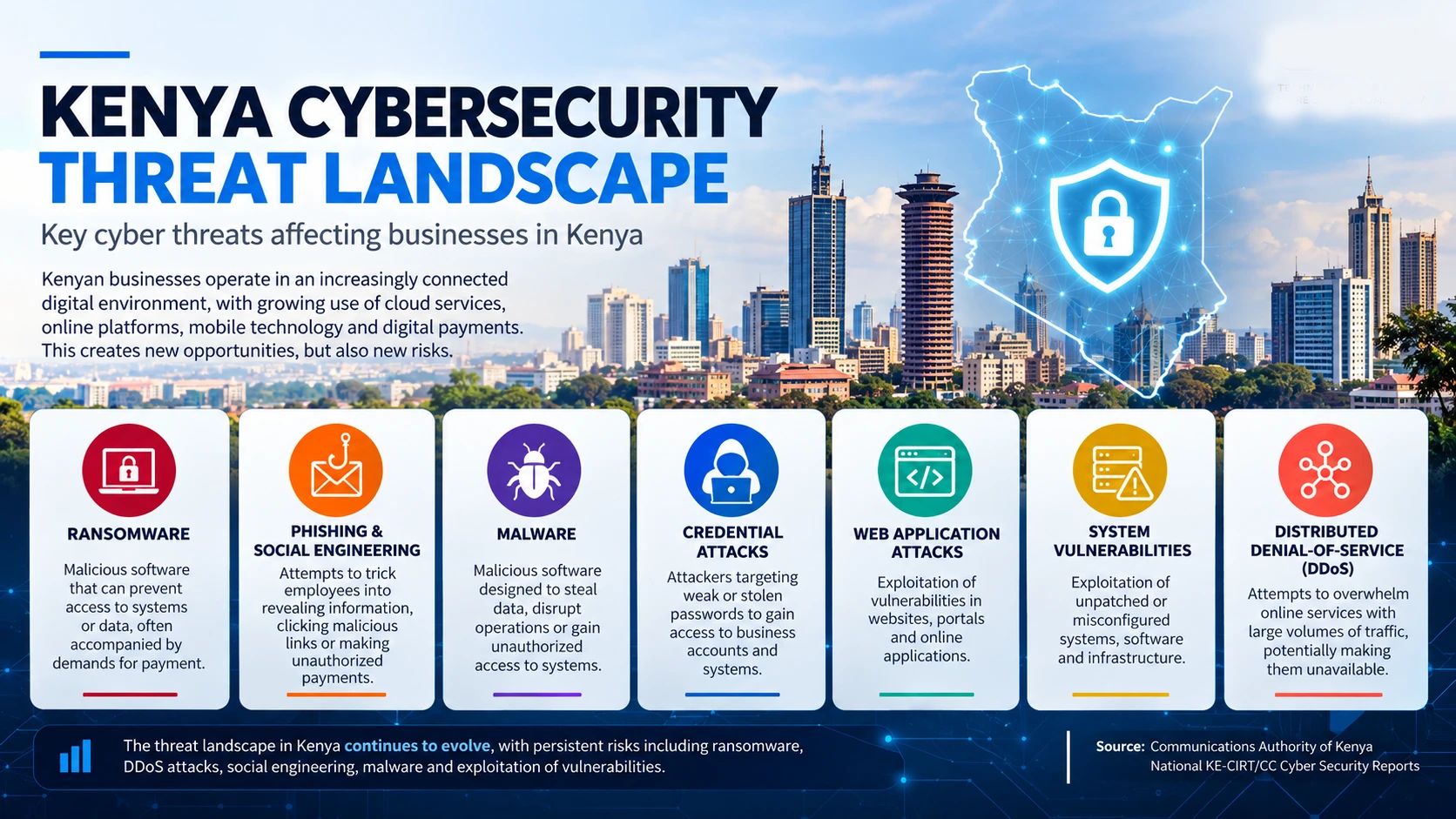
Kenyan organizations operate in an increasingly connected digital environment.
The Communications Authority of Kenya publishes regular cybersecurity reports covering threats detected and handled through the National KE-CIRT/CC. These reports provide an important picture of the changing threat landscape in the country.
Recent official reporting has highlighted threats including:
- Ransomware
- Distributed denial-of-service attacks
- Social engineering
- Malware
- Exploitation of vulnerabilities
- Brute-force attacks
- Web application attacks
- Advanced persistent threats
- Supply-chain attacks
- Zero-day exploitation
- AI-enabled cyber threats
The threat landscape changes continuously, which means businesses should avoid relying on a security strategy that was designed several years ago.
A good cybersecurity programme should be reviewed as the organization’s technology, workforce and risk profile change.
The Most Common Cybersecurity Threats Facing Kenyan Businesses
1. Phishing and Social Engineering
Phishing is one of the most common ways attackers attempt to trick people into revealing information, clicking malicious links, opening dangerous files or making unauthorized payments.
A phishing message may appear to come from:
- A bank
- A supplier
- A customer
- A colleague
- A company director
- A government agency
- A technology provider
Social engineering goes beyond email.
An attacker may use phone calls, messaging platforms, social media or other communication channels to manipulate an employee.
How businesses can reduce phishing risk
Businesses should:
- Enable multi-factor authentication
- Train employees to identify suspicious messages
- Establish procedures for verifying unusual payment requests
- Encourage employees to report suspicious activity
- Protect business email accounts
- Avoid relying solely on the appearance of an email address
- Use appropriate email security controls
Security awareness should be continuous rather than a once-a-year exercise.
2. Ransomware
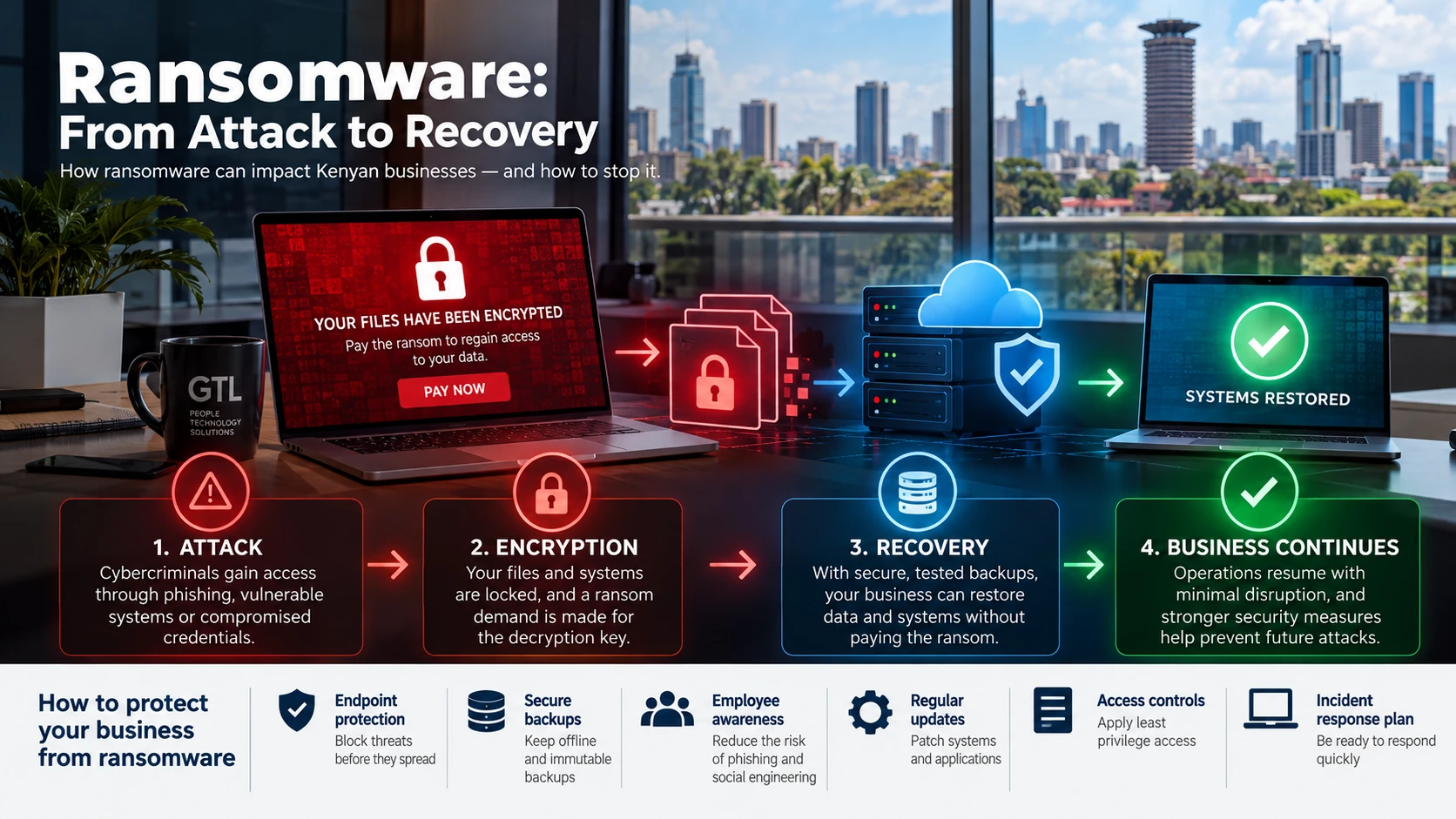
Ransomware is malicious software that can prevent an organization from accessing its systems or data.
Some ransomware campaigns also involve data theft and threats to publish stolen information.
This creates two major risks:
Availability: The business cannot access its systems or files.
Confidentiality: Sensitive information may have been stolen.
How businesses can prepare for ransomware
A ransomware protection strategy should include several layers:
- Strong identity controls
- Multi-factor authentication
- Endpoint protection
- Regular security updates
- Restricted administrator privileges
- Network segmentation where appropriate
- Reliable backups
- Tested recovery procedures
- Employee awareness
- Incident response planning
Backups are particularly important, but simply having a backup is not enough.
Businesses should regularly test whether critical information can actually be restored.
3. Malware
Malware is a broad term for malicious software designed to compromise systems, steal information, disrupt operations or provide unauthorized access.
It includes different types of malicious software such as:
- Trojans
- Spyware
- Ransomware
- Information stealers
- Remote-access malware
Malware can reach an organization through phishing, malicious downloads, compromised websites, vulnerable software and infected devices.
Modern endpoint security can help organizations detect suspicious behaviour and investigate activity that may indicate a compromise.
4. Business Email Compromise
Business Email Compromise, commonly called BEC, involves attackers using compromised or impersonated email accounts to deceive businesses.
For example, an attacker may impersonate a senior manager and request an urgent payment.
Another scenario involves compromising a supplier’s email account and sending fraudulent banking information.
Protecting your business from email-based fraud
Businesses should:
- Enable MFA on business email
- Protect administrator accounts
- Train finance and management teams
- Verify unusual payment instructions through another communication channel
- Establish payment approval procedures
- Review suspicious account activity
- Remove unnecessary user access
A payment request should not be considered legitimate simply because it appears to come from someone familiar.
5. Password and Credential Attacks
Compromised credentials can give attackers access to email, cloud applications, financial systems and other business resources.
Common weaknesses include:
- Reused passwords
- Weak passwords
- Shared accounts
- Excessive privileges
- Former employees retaining access
- Lack of multi-factor authentication
Businesses should consider:
- Strong, unique passwords
- Password managers where appropriate
- Multi-factor authentication
- Role-based access
- Regular access reviews
- Prompt removal of unnecessary accounts
MFA should be prioritized for email, administrator accounts, financial applications and other systems containing sensitive information.
6. Vulnerable and Outdated Software
Software vulnerabilities can provide attackers with opportunities to gain unauthorized access or compromise systems.
This can affect:
- Operating systems
- Websites
- Plugins
- Business applications
- Servers
- Network equipment
- Cloud services
Businesses should know what technology they operate and keep important systems updated.
A basic vulnerability-management process should answer four questions:
What systems do we have?
Which software versions are installed?
Which systems are exposed to the internet?
Which security updates are outstanding?
7. Web Application Attacks
Websites, e-commerce stores, customer portals and business applications can become targets for attackers.
Potential weaknesses include:
- Vulnerable software
- Weak authentication
- Poor access controls
- Insecure APIs
- Outdated plugins
- Misconfigured servers
- Application vulnerabilities
Organizations operating public-facing applications should treat application security as an ongoing responsibility.
This includes keeping software updated, restricting administrative access and monitoring for suspicious activity.
8. Distributed Denial-of-Service Attacks
A Distributed Denial-of-Service attack, commonly called a DDoS attack, attempts to overwhelm an online service with traffic.
The goal may be to make a website, application or other online service difficult or impossible for legitimate users to access.
Businesses that depend heavily on online services should consider appropriate resilience measures, depending on their infrastructure and risk profile.
These may include traffic monitoring, rate limiting, resilient hosting and specialized DDoS protection.
9. Cloud Security Risks
Moving systems to the cloud does not eliminate cybersecurity responsibilities.
Cloud environments can still be affected by:
- Weak authentication
- Excessive permissions
- Misconfigured storage
- Insecure APIs
- Exposed services
- Poor administrator controls
- Unmonitored accounts
Businesses should understand their responsibilities when using cloud services.
The cloud provider secures parts of the underlying infrastructure, but customers remain responsible for many aspects of how their accounts, data and applications are configured and used.
10. Insider Threats
Cybersecurity incidents do not always originate outside an organization.
An insider threat can involve:
- A malicious employee
- A compromised employee account
- Accidental data disclosure
- Excessive user privileges
- Former employees retaining access
- Unauthorized use of applications
Businesses can reduce this risk by applying the principle of least privilege.
Employees should have access to the information and systems they need to perform their roles, rather than automatically receiving access to everything.
Cybersecurity and Data Protection in Kenya
Cybersecurity and data protection are closely related, but they are not identical.
Cybersecurity focuses on protecting systems, networks, devices, applications and information.
Data protection focuses on how personal data is collected, processed, stored, shared and protected.
Kenya’s Data Protection Act, 2019 established the Office of the Data Protection Commissioner (ODPC) and provides a legal framework for the protection of personal data and privacy.
Businesses that process personal data should therefore consider both questions:
How do we protect our systems?
and:
How do we responsibly process and protect personal data?
What happens when there is a personal data breach?
Businesses should understand their responsibilities before an incident happens.
Where a personal data breach meets the applicable legal threshold, the relevant notification obligations under Kenya’s data protection framework must be considered.
The ODPC provides a mechanism for reporting data breaches and asks organizations to provide information including when the breach was discovered, how it occurred and the number of affected data subjects.
A business should therefore have a documented process for:
- Detecting an incident
- Assessing its scope
- Escalating it internally
- Preserving relevant information
- Determining whether notification obligations apply
- Communicating appropriately
- Remediating the underlying problem
Legal and regulatory decisions should be made with appropriate professional advice where necessary.
What Does Good Cybersecurity Look Like?
There is no single cybersecurity product that can protect every part of a business.
Effective cybersecurity uses multiple layers.
1. Identity and Access Security
Protect accounts with:
- Multi-factor authentication
- Strong passwords
- Least-privilege access
- Regular access reviews
- Privileged account controls
2. Endpoint Security
Protect:
- Laptops
- Desktops
- Servers
- Cloud workloads
- Other supported connected devices
3. Network Security
Use appropriate:
- Firewalls
- Network segmentation
- Secure Wi-Fi
- Access controls
- Monitoring
4. Application Security
Keep websites and applications updated and properly configured.
5. Data Security
Protect important information through appropriate:
- Access controls
- Encryption
- Secure storage
- Backups
- Retention policies
6. Security Awareness
Employees should understand the threats they are likely to encounter and know how to report them.
7. Backup and Recovery
Maintain reliable backups and test recovery procedures.
8. Incident Response
Know who does what when an incident occurs.
9. Continuous Improvement
Review security controls regularly and improve them as the organization changes.
Endpoint Security for Kenyan Businesses
Every laptop, desktop and server can become an entry point for an attacker.
Endpoint security helps organizations protect these devices and gain greater visibility into suspicious activity.
Depending on the solution, endpoint protection can help with:
- Threat prevention
- Detection
- Investigation
- Response
- Device visibility
- Malware protection
GTL works with SentinelOne as part of its cybersecurity technology offering.
SentinelOne provides endpoint security capabilities that can include protection, detection and response across supported endpoints, servers, cloud workloads and other environments.
The appropriate solution depends on an organization’s size, infrastructure, risk profile and security requirements.
Explore GTL’s SentinelOne solutions
Cyber Resilience: Preparing for What Happens After an Attack
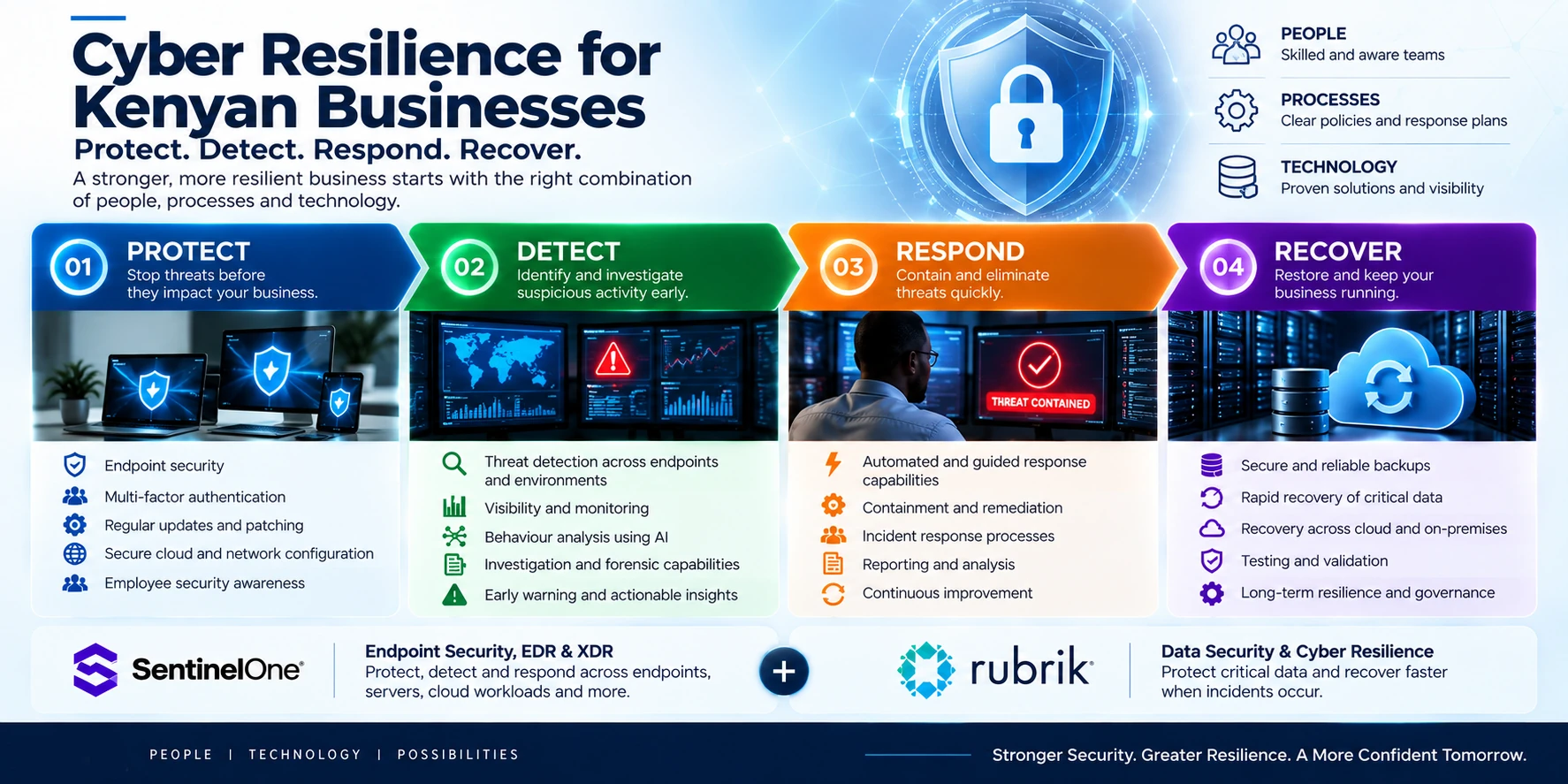
Good cybersecurity is not only about preventing attacks.
Businesses should also prepare for the possibility that an attacker gets through.
This is where cyber resilience becomes important.
A resilient organization should be able to:
- Detect an incident
- Contain the problem
- Protect critical information
- Restore important systems
- Resume business operations
- Learn from the incident
- Improve its security controls
This is why cybersecurity and data recovery should be considered together.
GTL also works with Rubrik, a technology provider focused on data security, data protection and recovery.
The broader principle is simple:
Protect. Detect. Respond. Recover.
The specific technologies required will depend on the organization’s environment and business requirements.
Explore GTL’s Rubrik data security solutions
Cybersecurity Checklist for Kenyan Businesses
Use this checklist as a starting point.
Identity and Access
-
MFA is enabled for important accounts
-
Strong and unique passwords are used
-
Former employee accounts are removed
-
Administrator privileges are restricted
-
User access is reviewed regularly
Devices
-
Endpoint protection is deployed
-
Operating systems are updated
-
Applications are patched
-
Security software is monitored
-
Unnecessary software is removed
-
Business email is protected with MFA
-
Phishing controls are in place
-
Employees receive security awareness training
-
Unusual payment requests are independently verified
Data
-
Critical business data has been identified
-
Sensitive information is appropriately restricted
-
Important data is backed up
-
Backups are tested
-
Data protection responsibilities are understood
Network
-
Firewall controls are appropriately configured
-
Business Wi-Fi is secured
-
Network access is controlled
-
Important systems are appropriately segmented where necessary
People
-
Employees receive cybersecurity awareness training
-
Employees know how to report suspicious activity
-
Security responsibilities are clearly assigned
Incident Response
-
An incident response plan exists
-
Key contacts are documented
-
Recovery procedures are documented
-
Business continuity arrangements exist
-
Data breach responsibilities are understood
If several of these areas are missing or unclear, the business may benefit from a cybersecurity assessment.
How to Build a Cybersecurity Strategy
A cybersecurity programme does not need to start with expensive technology.
Start with understanding the business.
Step 1: Identify Your Critical Assets
Create an inventory of:
- Devices
- Servers
- Applications
- Websites
- Cloud services
- Business data
- User accounts
You cannot properly protect assets that you do not know you have.
Step 2: Identify Your Biggest Risks
Ask:
- What would happen if our email was compromised?
- What would happen if our accounting system became unavailable?
- What information would cause serious harm if stolen?
- Which systems are exposed to the internet?
- What would happen if ransomware encrypted our files?
- How quickly could we recover?
These questions help turn cybersecurity into a business discussion.
Step 3: Strengthen the Fundamentals
Prioritize:
- MFA
- Strong passwords
- Patching
- Endpoint protection
- Backups
- Employee awareness
- Access controls
Step 4: Add Advanced Controls
As the organization’s size and risk increase, it may need additional capabilities such as:
- Endpoint Detection and Response
- Extended Detection and Response
- Vulnerability management
- Security monitoring
- Threat intelligence
- Advanced email security
- Network segmentation
- Data security
- Incident response
Not every organization needs every technology.
The goal is to match controls to actual business risks.
Step 5: Test Your Defences
Do not assume that a security control works simply because it has been installed.
Test:
- Backup restoration
- Account recovery
- Incident response
- Access controls
- Employee awareness
- Vulnerability management
Step 6: Review Regularly
Cybersecurity is not a one-time project.
Your systems change.
Your employees change.
Your applications change.
Your business changes.
Your cybersecurity strategy should change with them.
How Much Does Cybersecurity Cost in Kenya?
There is no single cybersecurity price that applies to every Kenyan business.
The cost depends on factors such as:
- Number of users
- Number of devices
- Servers
- Cloud infrastructure
- Business applications
- Industry
- Data sensitivity
- Existing security controls
- Required monitoring
- Recovery requirements
A small business may begin with fundamental controls such as MFA, secure backups, employee awareness and endpoint protection.
A larger organization may require a broader programme involving endpoint security, vulnerability management, data security, monitoring, incident response and recovery capabilities.
The objective should not be to buy the largest number of cybersecurity products.
It should be to reduce the risks that matter most to the business.
Cybersecurity for Small Businesses in Kenya
Small businesses may not have dedicated cybersecurity teams, but that does not mean security should be ignored.
Start with the fundamentals:
- Protect business email.
- Enable MFA.
- Use strong passwords.
- Keep systems updated.
- Protect endpoints.
- Train employees.
- Maintain reliable backups.
- Control access to sensitive information.
- Secure websites and applications.
- Create an incident response plan.
For more detailed guidance, see GTL’s dedicated guide:
Cybersecurity for Small Businesses in Kenya
Cybersecurity for Different Industries
Cybersecurity requirements vary between industries.
A financial services organization may need to focus heavily on financial fraud, identity protection, access controls and regulatory requirements.
A manufacturer may need to protect production systems, operational technology and intellectual property.
A retailer may need to protect customer information, payment systems and e-commerce platforms.
A professional services company may hold sensitive client information.
A healthcare organization may process highly sensitive personal information.
For this reason, cybersecurity should be based on business risk and industry requirements, rather than copying another company’s technology stack.
Common Cybersecurity Mistakes Businesses Make
Relying only on antivirus
Antivirus is useful, but it is only one part of a broader security strategy.
Assuming small businesses are not targeted
Automated attacks can target large numbers of systems without attackers knowing the size of the business in advance.
Ignoring software updates
Known vulnerabilities can create opportunities for attackers.
Having backups but never testing them
A backup is valuable only if the business can successfully restore what it needs.
Giving users excessive access
Compromised accounts can cause greater damage when users have unnecessary privileges.
Training employees only once
Cybersecurity awareness should be continuous.
Waiting until an attack happens
Incident response is easier when responsibilities and procedures are established before an emergency.
Buying cybersecurity products without a strategy
Technology should address identified risks rather than simply increasing the number of tools an organization owns.
How GTL Can Help
Cybersecurity is most effective when technology is combined with appropriate planning, implementation and ongoing management.
GTL provides enterprise technology solutions to organizations across Kenya and Africa, including cybersecurity technologies from established global vendors.
SentinelOne
Endpoint Security, Detection and Response
GTL’s SentinelOne offering can help organizations strengthen protection across supported endpoints and other environments.
Rubrik
Data Security and Cyber Resilience
Rubrik technologies can help organizations protect critical data and strengthen recovery capabilities.
These technologies address different parts of a broader cybersecurity and resilience strategy.
The right combination depends on the organization’s systems, risk profile and business requirements.
Talk to GTL about cybersecurity solutions
Is Your Business Ready for a Cyberattack?
You do not have to wait for ransomware, a compromised email account or a data breach to discover weaknesses in your security.
A cybersecurity assessment can help identify areas that require attention, including:
- Weak access controls
- Vulnerable systems
- Endpoint risks
- Backup gaps
- Employee awareness gaps
- Data protection concerns
- Incident response weaknesses
Start with a cybersecurity assessment
Talk to GTL about reviewing your organization’s cybersecurity posture.
Request a Cybersecurity Consultation
Frequently Asked Questions About Cybersecurity for Businesses in Kenya
What is cybersecurity for businesses?
Cybersecurity for businesses involves protecting an organization’s devices, systems, applications, accounts, networks and information from unauthorized access, disruption, theft, damage and other cyber threats.
Why is cybersecurity important for businesses in Kenya?
Kenyan businesses increasingly rely on digital systems, cloud services, online platforms and connected devices. Protecting these systems helps reduce the risk of disruption, data loss, fraud and unauthorized access.
What are the main cybersecurity threats in Kenya?
Major threats include phishing, social engineering, ransomware, malware, credential attacks, exploitation of vulnerabilities, web application attacks and distributed denial-of-service attacks. The specific risks vary between organizations.
How can a small business improve cybersecurity?
Start with MFA, strong passwords, regular updates, endpoint protection, employee awareness, reliable backups and appropriate access controls. Businesses should also have a basic incident response process.
Is antivirus enough for a business?
No single security product provides complete protection against every threat. Antivirus or endpoint protection should form part of a broader security strategy that may also include MFA, patching, backups, access controls, employee awareness and incident response.
What is endpoint security?
Endpoint security protects devices such as computers and servers from cyber threats. Modern endpoint security can also provide visibility into suspicious activity and support investigation and response.
What is EDR?
EDR stands for Endpoint Detection and Response. EDR technology monitors endpoint activity to help organizations detect, investigate and respond to suspicious or malicious behaviour.
What is XDR?
XDR stands for Extended Detection and Response. It extends security detection and response beyond individual endpoints by bringing together security information from multiple environments or layers.
What is ransomware?
Ransomware is malicious software that can prevent an organization from accessing systems or data. Some attacks also involve stealing information and threatening to release it.
How can a business protect itself from ransomware?
Businesses should use multiple layers of protection, including MFA, endpoint security, regular patching, restricted privileges, employee awareness, reliable backups and tested recovery procedures.
What should a business do after a cyberattack?
The organization should activate its incident response process, contain the incident where appropriate, preserve relevant evidence, assess the impact and seek appropriate technical, legal and regulatory assistance. If personal data is involved, the organization should also assess its obligations under Kenya’s data protection framework.
Does the Data Protection Act apply to businesses in Kenya?
The Data Protection Act, 2019 provides Kenya’s legal framework for the protection of personal data and establishes the Office of the Data Protection Commissioner. Organizations that process personal data should understand the requirements applicable to their activities.
How often should a business review cybersecurity?
Cybersecurity should be monitored continuously and formally reviewed whenever there are significant changes to systems, applications, employees, infrastructure or business operations.
Make Cybersecurity Part of How You Run Your Business
Cybersecurity for businesses in Kenya is no longer simply an IT issue.
It is a business risk.
As organizations adopt cloud applications, digital payments, online platforms, remote working tools and connected technologies, the importance of protecting digital systems and information continues to grow.
The strongest approach is not to buy every security product available.
It is to understand your risks and build appropriate layers of protection around the business.
Start with the fundamentals.
Protect accounts.
Secure endpoints.
Keep software updated.
Train employees.
Maintain reliable backups.
Control access.
Prepare for incidents.
Review your security regularly.
Then strengthen your controls as the organization grows.
GTL can help businesses evaluate and implement appropriate cybersecurity and cyber-resilience technologies, including SentinelOne and Rubrik solutions.
Do not wait for an attack to show you where your weaknesses are.
Talk to GTL about strengthening your cybersecurity posture.
Request a Cybersecurity Consultation
Further Reading
- Top Cybersecurity Threats Facing Kenyan Businesses
- Cybersecurity for Small Businesses in Kenya
- SentinelOne Cybersecurity Solutions
- Rubrik Data Security and Cyber Resilience
- GTL Cybersecurity Solutions
Cybersecurity Resources
- Communications Authority of Kenya / National KE-CIRT/CC
- Office of the Data Protection Commissioner
- National Computer and Cybercrimes Coordination Committee
- Kenya National Cybersecurity Strategy
Last reviewed: October 2026
Editorial note: Cybersecurity threats, regulations and recommended controls change over time. This guide should be reviewed periodically and should not be treated as legal advice or a substitute for a professional cybersecurity assessment.