Finding the cheapest ERP system in Kenya can seem like a straightforward exercise. Search online, compare subscription prices, identify the lowest quotation and choose the system that fits your budget.
However, this approach can become expensive in the long run.
An ERP system is not just another software subscription. It connects important business operations, including accounting, inventory, procurement, sales, customer management, warehousing and reporting. Choosing a system based only on its initial price can leave a business with additional implementation costs, disconnected processes and software that cannot support its growth.
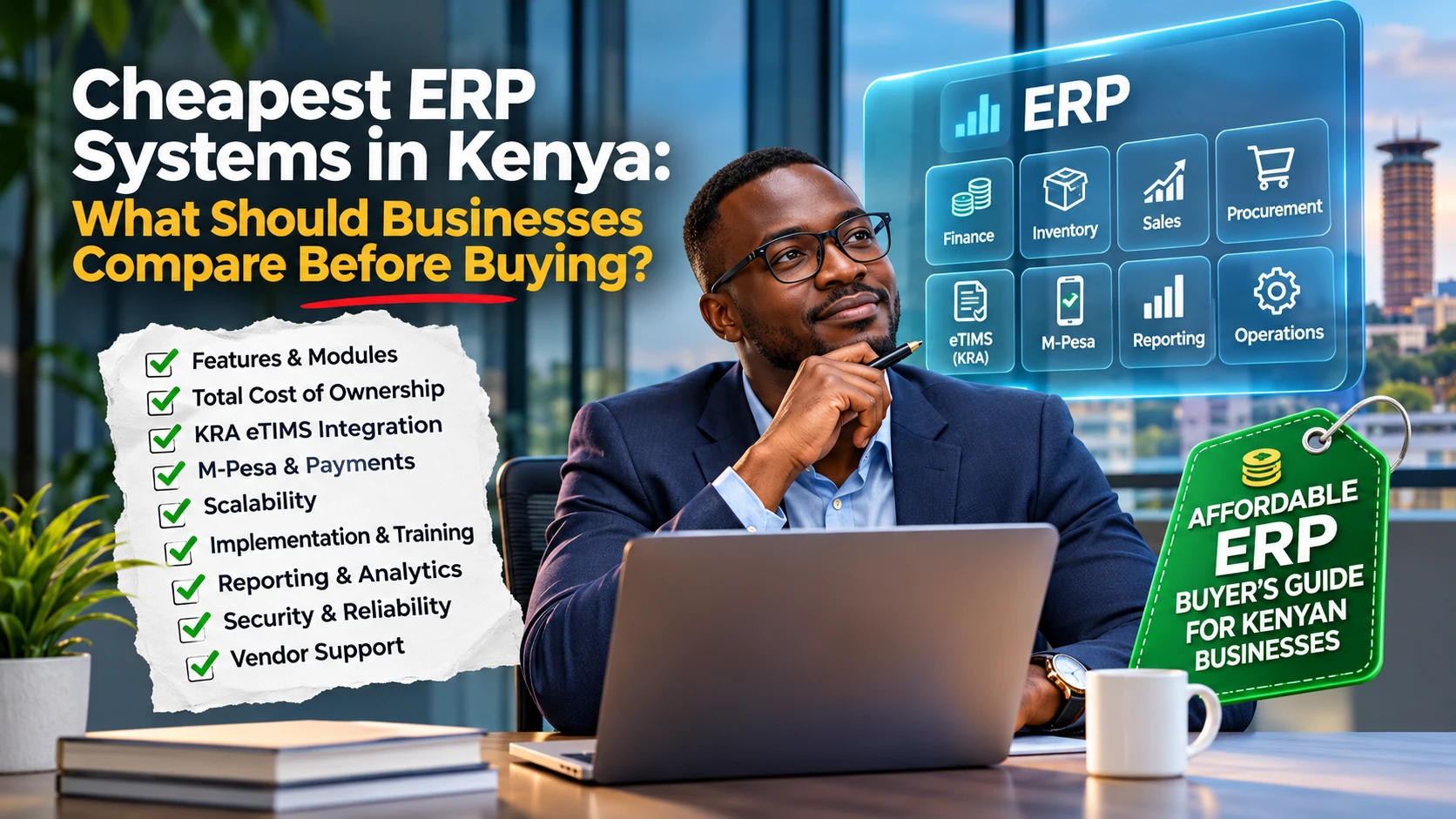
For Kenyan businesses, the decision also involves practical considerations such as KRA eTIMS integration, local support, M-Pesa workflows, multiple branches and the ability to generate accurate financial and operational reports.
So, what is the cheapest ERP system in Kenya, and how can you identify one that offers genuine value?
The answer depends on your business requirements, the number of people who will use the system and the processes you want to manage. This guide explains what to compare before making an ERP investment.
What Does an ERP System Actually Cost?
ERP software pricing varies depending on the platform, deployment model, number of users, selected modules and implementation requirements.
Some platforms operate on monthly or annual subscriptions. Others use perpetual licences, while certain open-source systems have no software licensing fees but require businesses to pay for hosting, configuration, maintenance and technical support.
It is important to distinguish between three costs:
- Software licensing: The cost of accessing and using the ERP platform.
- Implementation: The cost of configuring the system, migrating existing data, integrating applications and preparing it for use.
- Ongoing operations: Hosting, maintenance, technical support, upgrades and additional services.
A system with a low monthly subscription may become expensive when additional modules, integrations and support services are introduced.
Similarly, an ERP platform with a higher initial investment may provide better long-term value if it replaces several disconnected applications and reduces manual work.
Businesses should therefore evaluate the total cost of ownership rather than focusing exclusively on the advertised price.
9 Things to Compare When Choosing an Affordable ERP System in Kenya
1. Understand What Is Included in the ERP Package
Start by identifying the business functions you want the ERP system to manage.
Some businesses only need accounting, invoicing and basic inventory management. Others require a more comprehensive solution covering procurement, warehouse operations, manufacturing, sales, customer relationships and financial reporting.
Before comparing prices, establish which modules are included in each package.
Consider whether the system provides:
- Financial management and accounting.
- Sales and order management.
- Inventory and stock control.
- Procurement and supplier management.
- Customer relationship management (CRM).
- Warehouse management.
- Human resource management.
- Manufacturing and production planning.
- Business intelligence and reporting.
You do not necessarily need every module from the beginning. However, the ERP should allow your organisation to introduce additional functionality as its requirements change.
For example, a wholesale distributor may initially prioritise inventory, procurement and financial management. As operations expand, warehouse management, customer relationship management and advanced reporting may become equally important.
The objective is to avoid paying for unnecessary functionality while ensuring that essential business processes are properly covered.
2. Compare the Total Cost of Ownership
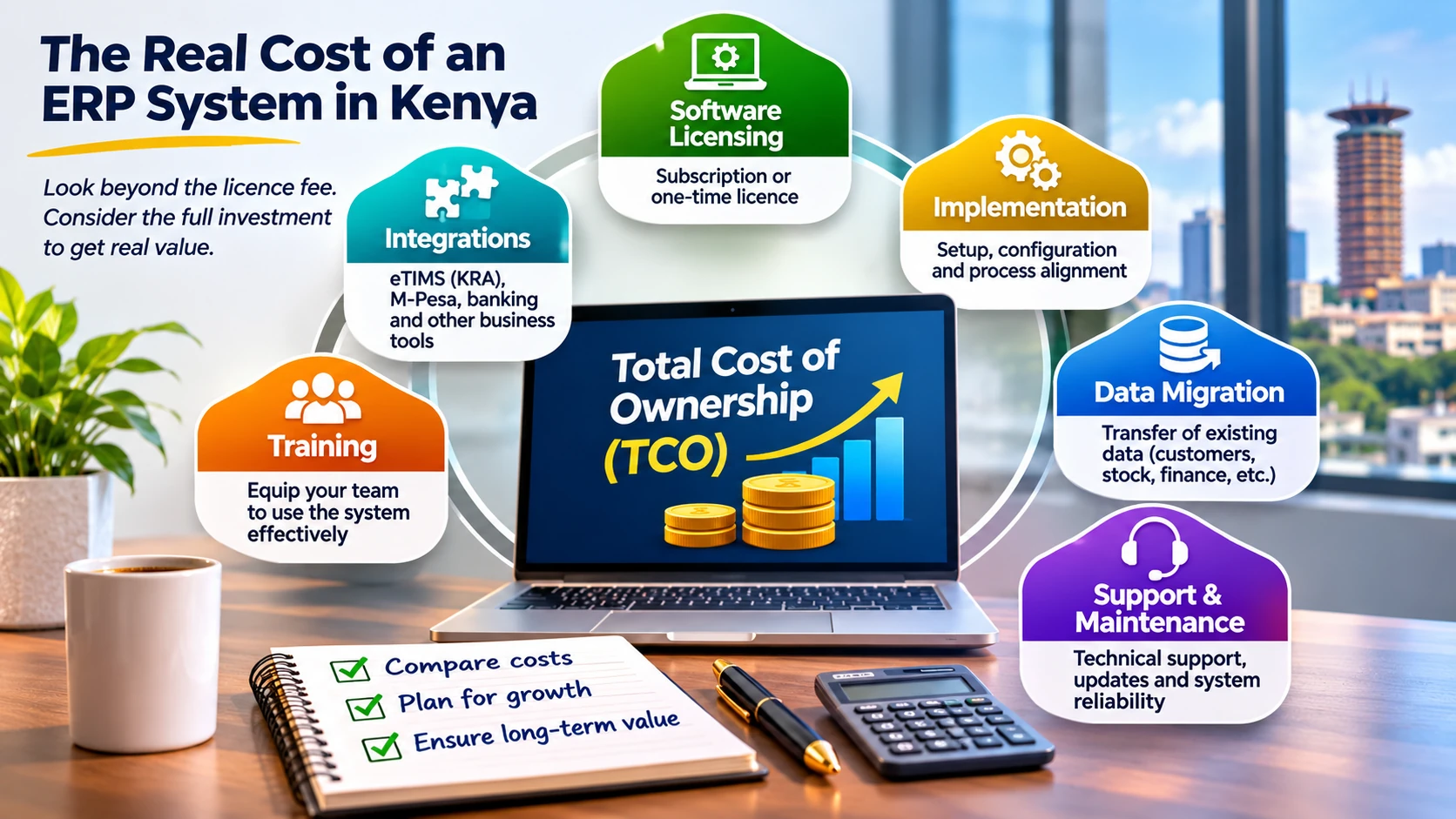
One of the biggest mistakes businesses make when searching for the cheapest ERP system in Kenya is comparing licence fees without considering implementation and ongoing expenses.
A proper ERP investment assessment should account for:
Software licensing: Is the system purchased once, or does it require monthly or annual subscriptions?
Implementation and configuration: Does the quoted price include setting up the system according to your business processes?
Data migration: Will the implementation partner transfer existing customer records, supplier information, inventory and financial data?
Training: Are employees trained to use the system effectively?
Integrations: Are connections to eTIMS, payment platforms, existing applications and other business systems included?
Maintenance and support: What happens when the business encounters technical problems or requires system updates?
Future expansion: Will adding users, branches or modules significantly increase the cost?
Request a breakdown of these costs before committing to a vendor.
A transparent quotation makes it easier to understand what you are paying for and identify potential expenses that may arise later.
3. Check Whether the ERP Supports KRA eTIMS
For businesses operating in Kenya, tax invoicing and compliance should be part of the ERP selection process.
The Kenya Revenue Authority provides eTIMS solutions for businesses to generate electronic tax invoices. Businesses with existing invoicing or ERP systems can also explore system-to-system integration.
KRA provides two main system-to-system integration options:
- Virtual Sales Control Unit (VSCU): Designed for businesses with extensive transactions or bulk invoicing, including systems that are not always online.
- Online Sales Control Unit (OSCU): Designed for businesses using online invoicing systems.
The appropriate option depends on the business’s invoicing environment and technical requirements.
When evaluating an ERP system, ask the vendor:
- Does the system support eTIMS integration?
- Is the integration already implemented or does it require additional development?
- Are the relevant integration and certification requirements addressed?
- Who handles technical support when invoicing problems occur?
- Are integration maintenance and future updates included?
It is worth noting that KRA provides its own eTIMS software free of charge. However, businesses that choose to integrate their existing invoicing or ERP systems through third-party providers may incur additional costs.
Do not assume that an ERP system is automatically eTIMS-compliant simply because it supports invoicing.
Verify the actual integration arrangement before purchasing.
4. Evaluate M-Pesa and Other Payment Integrations
Mobile money plays an important role in Kenya’s business environment.
For businesses receiving payments through M-Pesa, the ability to reconcile transactions with invoices and financial records can make a significant difference to daily operations.
Consider whether your preferred ERP can support:
- M-Pesa payment integration.
- Bank transaction reconciliation.
- Customer payment tracking.
- Automated receipt generation.
- Accounts receivable management.
- Payment allocation against outstanding invoices.
The extent of integration varies between ERP platforms and implementation partners.
For example, a business may only need to record payments manually, while a high-volume distributor may benefit from automated payment reconciliation.
Choose a solution that matches the complexity of your payment operations rather than paying for integrations you will not use.
5. Consider Scalability and the Cost of Adding Users
A system that works for a business with five employees may not necessarily work for an organisation with 50 employees, several departments and multiple branches.
Before choosing an affordable ERP, understand how its pricing changes as the business grows.
Find out:
- How many users are included in the package?
- What is the cost of adding another user?
- Can the system support multiple branches?
- Can different departments access the modules they need?
- Does it support multiple companies or business entities?
- Can it handle increasing transaction volumes?
- Can additional modules be introduced without replacing the system?
Per-user subscriptions can be attractive for smaller organisations. However, the costs may increase considerably as more employees require access.
A scalable ERP should allow the organisation to expand its operations without having to replace its entire business management platform.
6. Look Beyond the Software: Evaluate Implementation and Training
Purchasing ERP software does not automatically improve business operations.
The system must be configured around the organisation’s actual processes, employees must understand how to use it, and existing business information must be migrated correctly.
This is where implementation becomes particularly important.
A good ERP implementation process should include:
- Business requirements assessment.
- Process mapping and system configuration.
- Data preparation and migration.
- Integration with relevant business applications.
- Testing and user acceptance.
- Employee training.
- Deployment and post-implementation support.
Ask prospective vendors who will handle these activities and whether they are included in the quotation.
Also, find out whether training is provided to different departments, including finance, sales, procurement, warehouse and management teams.
An inexpensive system that employees cannot use properly may create more operational problems than it solves.
7. Evaluate Reporting and Business Intelligence Capabilities
An ERP system should help management understand what is happening across the organisation.
Without reliable reporting, businesses may continue depending on manually prepared spreadsheets to understand sales performance, stock levels, expenses and financial results.
Evaluate whether the system can provide:
- Real-time financial reports.
- Sales performance reports.
- Inventory valuation and stock movement reports.
- Procurement and supplier reports.
- Accounts receivable and payable reports.
- Profitability analysis.
- Management dashboards.
- Departmental performance reports.
Consider the reports your management team needs to make decisions.
For example, a manufacturing business may need to monitor production costs, material consumption and production efficiency. A distributor may prioritise stock movement, supplier performance and sales margins.
The value of an ERP system is not simply the amount of information it stores. It is how effectively that information helps the business make better decisions.
8. Check Data Security, Access Controls and System Reliability
ERP systems contain sensitive business information, including financial records, customer details, supplier information and operational data.
Security should therefore be part of the purchasing decision.
Ask prospective providers about:
- User roles and access permissions.
- Data encryption.
- Backup frequency and recovery procedures.
- Audit trails and activity logs.
- Authentication and account security.
- Hosting infrastructure.
- Disaster recovery arrangements.
- Data ownership and export options.
It is also important to understand what happens if the ERP provider changes its service arrangements or your business decides to move to another platform.
You should be able to establish how your business data can be accessed, exported and transferred.
A low-cost ERP system should not expose your organisation to unnecessary data security or business continuity risks.
9. Evaluate the Vendor’s Experience and Ongoing Support
An ERP implementation is not a one-time software purchase. Your organisation may need assistance with configuration, additional modules, system upgrades, reporting and integrations as its requirements evolve.
The vendor or implementation partner therefore matters just as much as the software.
Before making a decision, consider:
- Experience implementing ERP systems for businesses of a similar size.
- Understanding of your industry.
- Availability of local technical support.
- Response times for technical issues.
- Experience with integrations and customisation.
- Availability of user training.
- Long-term product support.
- Ability to support future business expansion.
Request a demonstration and, where possible, speak to existing customers.
A reliable implementation partner should be able to explain how the proposed ERP will address your specific business challenges rather than simply demonstrate a list of software features.
Which ERP System Is Right for Your Business?
There is no universally cheapest ERP system because different platforms serve different business requirements.
For a small business that primarily needs invoicing and basic accounting, a lightweight business management solution may be sufficient.
A growing organisation that manages multiple departments, warehouses, suppliers and customers may require a more comprehensive ERP platform.
Here are some general considerations:
| Business requirement | What to prioritise |
|---|---|
| Small businesses | Accounting, invoicing and basic inventory |
| Wholesale and distribution | Inventory, procurement, sales and warehouse management |
| Manufacturing | Production planning, inventory, purchasing and costing |
| Retail businesses | Stock control, sales, POS and financial reporting |
| Construction | Project costing, procurement and financial management |
| Growing multi-branch businesses | Centralised operations, reporting and multi-branch management |
The important thing is to select a system that addresses your current operational challenges while providing room for future growth.
Why Growing Businesses Should Look Beyond Basic ERP Software
As an organisation expands, managing business operations through separate applications becomes increasingly difficult.
Finance may use one application, inventory may be managed through spreadsheets, sales teams may maintain separate customer records, and procurement may operate independently.
This creates information gaps and makes it difficult for management to obtain a reliable picture of business performance.
An integrated ERP system helps bring these functions together.
For organisations that need comprehensive business management capabilities, Priority ERP is one solution worth evaluating.
Priority ERP supports business functions including:
- Financial management.
- Sales and customer relationship management.
- Procurement and purchasing.
- Inventory and warehouse management.
- Manufacturing and production.
- Business reporting and analytics.
- Workflow and process management.
Through its partnership with Priority Software, Genome Technologies Limited (GTL) helps organisations assess, implement and customise ERP solutions according to their operational requirements.
The implementation process can include requirements assessment, system configuration, data migration, integrations, employee training and ongoing support.
Rather than recommending the same package to every organisation, the objective is to identify the functionality that will deliver the most value to the business.
Businesses can explore GTL’s ERP software solutions in Kenya to learn more.
Questions to Ask Before Purchasing an ERP System
Before signing a contract, use these questions to evaluate the proposed solution:
- What is the complete implementation cost?
- Which modules are included in the quotation?
- Are there additional licensing or subscription fees?
- Does the system support our required eTIMS integration?
- Can it integrate with our existing applications?
- What happens when we add more users or branches?
- Is data migration included?
- What training will our employees receive?
- What technical support is available after deployment?
- Can we see a demonstration using business scenarios similar to ours?
Getting clear answers to these questions will help you compare ERP vendors more objectively.
Frequently Asked Questions About Affordable ERP Systems in Kenya
What is the cheapest ERP system in Kenya?
There is no single ERP system that is cheapest for every business. Some platforms offer free or low-cost entry-level options, while others use subscription or licence-based pricing. The actual cost depends on users, modules, implementation, integrations and ongoing support. Businesses should compare total cost of ownership rather than software licence fees alone.
How much does ERP software cost in Kenya?
ERP software costs in Kenya vary significantly. Some solutions offer monthly subscriptions, while more comprehensive platforms require customised quotations. Implementation, data migration, training, integrations and ongoing support may also affect the final investment. Request a detailed quotation based on your business requirements.
Is free ERP software suitable for Kenyan businesses?
Free and open-source ERP platforms can be suitable for some businesses, particularly those with access to technical expertise. However, free software does not necessarily mean free implementation. Hosting, configuration, customisation, maintenance and support may still require investment.
Can ERP software integrate with KRA eTIMS?
Yes. ERP and invoicing systems can integrate with KRA eTIMS through approved system-to-system integration arrangements, including VSCU and OSCU. Businesses should confirm the integration capabilities and implementation requirements with their ERP provider.
Can small businesses afford ERP software?
Yes. Small businesses can start with ERP solutions that cover their essential requirements, such as accounting, inventory, invoicing and sales management. The important consideration is choosing a solution that can accommodate additional functionality as the business grows.
What is the difference between ERP software and accounting software?
Accounting software primarily manages financial activities such as invoicing, expenses, payments and financial reporting. ERP software connects financial management with other business processes, including procurement, inventory, sales, warehouse operations, manufacturing and customer management.
How long does ERP implementation take?
Implementation time depends on the size of the organisation, number of users, business processes, data migration requirements, integrations and level of customisation. A relatively straightforward implementation may take weeks, while complex multi-department or multi-branch deployments can take several months.
Should I choose cloud-based or on-premise ERP software?
Cloud-based ERP systems are generally accessed over the internet and can reduce the need for businesses to manage their own server infrastructure. On-premise systems provide greater control over deployment infrastructure but require appropriate hardware, maintenance and technical resources. The right choice depends on your security requirements, infrastructure, connectivity and operational preferences.
Final Thoughts: Choose Value, Not Just the Lowest Price
Finding the cheapest ERP system in Kenya should not be the ultimate objective. The real goal should be finding a solution that improves business efficiency without creating unnecessary financial or operational burdens.
Compare the software’s functionality, implementation costs, integrations, scalability, security and ongoing support before making a decision.
A well-selected ERP system can help your organisation reduce manual processes, improve information sharing, strengthen financial control and make better business decisions.
If your business is evaluating ERP solutions, start by identifying the operational challenges you want to address and the processes that need to work together.
Looking for an ERP solution that fits your business requirements?
Genome Technologies Limited can help you assess your needs and explore how Priority ERP can support your organisation’s financial management, inventory, procurement, sales and wider business operations.
Explore GTL’s ERP solutions or contact the GTL team to discuss your requirements.