
Choosing the right ERP software in Kenya is not simply a question of finding the system with the lowest licence price.
An ERP system can become the central platform for finance, procurement, sales, inventory, manufacturing, customer management, reporting and other business processes. The right choice therefore depends on what your organisation needs to control, automate and integrate.
There is also no single ERP system that is objectively the best for every Kenyan business.
A small company primarily looking for accounting and inventory management may have very different requirements from a manufacturer managing production planning, bills of materials, purchasing, warehouses and financial reporting.
For that reason, this guide compares several established ERP options available to Kenyan businesses using publicly available product and pricing information. Where a vendor does not publish a standard Kenyan price, we have not estimated one.
Quick comparison
| ERP system | Particularly suited to | Public pricing available? | Pricing model |
|---|---|---|---|
| Priority ERP | Growing and mid-sized businesses, manufacturing, distribution and broader enterprise operations | No standard Kenyan price published | Quote-based |
| Odoo | SMEs and organisations wanting a broad modular business platform | Yes | Per-user subscription |
| SAP Business One | Small and midsize companies requiring an established enterprise ERP | Quote-based | Quote |
| Microsoft Dynamics 365 Business Central | Organisations already invested in the Microsoft ecosystem | Yes, global list pricing | Per-user subscription |
| TallyPrime | Accounting, invoicing and inventory-focused businesses | Yes, Kenya pricing | Perpetual licence |
| Sage 300cloud | Established businesses requiring financial, distribution and inventory capabilities | Kenya product available; quote required for pricing | Quote-based |
| Oracle NetSuite | Organisations seeking a cloud business-management platform with broader enterprise capabilities | Quote-based | Quote |
The prices and features in this table should be treated as published product information, not as equivalent total project costs. Implementation, configuration, migration, integrations, training, support and local tax requirements can materially affect the final cost.
What Is ERP Software?
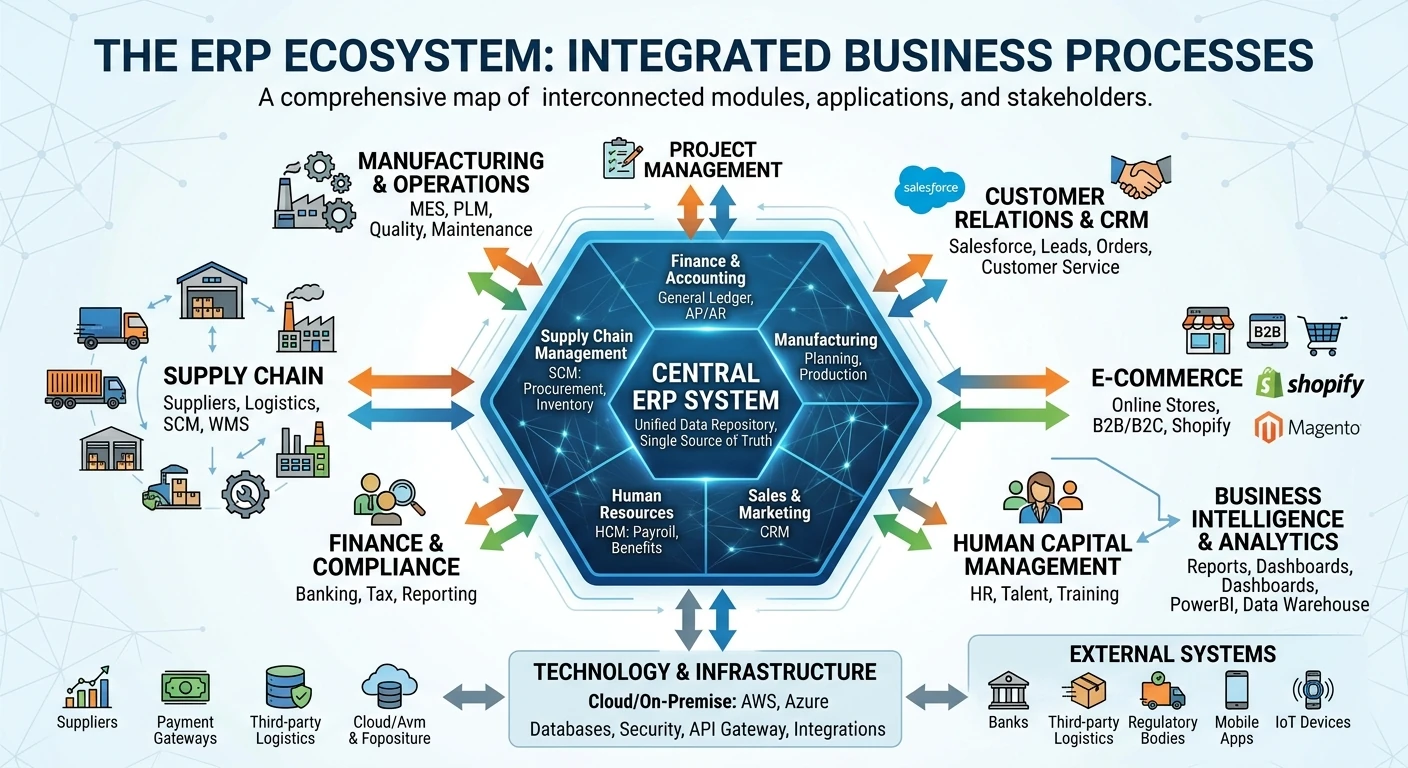
ERP stands for Enterprise Resource Planning.
An ERP system brings multiple business functions together within an integrated software environment.
Instead of maintaining disconnected systems for accounting, inventory, procurement, sales and operations, an ERP can connect these processes through shared business data.
For example:
Customer order → inventory allocation → purchasing → warehouse → invoicing → accounting → management reporting
The exact processes depend on the ERP platform and how it is configured.
Typical ERP capabilities include:
- Financial management
- Accounts payable and receivable
- General ledger
- Sales management
- Purchasing
- Inventory management
- Warehouse management
- Customer relationship management
- Manufacturing
- Procurement
- Project management
- Human resources
- Business intelligence and reporting
- Workflow automation
- Multi-company management
- Multi-branch operations
The important distinction is that an ERP is not simply accounting software with additional screens. A properly implemented ERP connects business processes so that information can move between departments without unnecessary duplication.
Why ERP Software Matters for Kenyan Businesses
Kenya’s business environment is becoming increasingly digital.
The Communications Authority of Kenya reported 62.6 million mobile data subscriptions in its Q3 FY2025/26 sector statistics, alongside more than 52.8 million mobile broadband subscriptions. The same report recorded more than 53.3 million mobile-money subscriptions.
The wider digital environment matters because businesses increasingly operate across online sales, mobile payments, digital invoicing, cloud applications and distributed teams.
Kenya’s tax environment has also made digital transaction records increasingly important.
KRA states that persons carrying on business are required to electronically generate and transmit invoices through eTIMS, and that business expenses generally need to be supported by valid electronic tax invoices for income-tax purposes, subject to applicable exceptions.
This means that when evaluating ERP software in Kenya, businesses should consider more than accounting functionality.
They should also evaluate:
- eTIMS requirements
- Tax reporting workflows
- Inventory records
- Data security
- Integration requirements
- Mobile access
- Payment processes
- Multi-branch requirements
- Local implementation support
- Scalability
An ERP should fit the organisation’s actual operating environment.
Kenya’s Business Environment and the Need for Scalable Systems
MSMEs form a major part of Kenya’s economy.
The State Department for MSME Development says MSMEs account for more than 90% of businesses and approximately 30% of GDP, while its broader MSME information highlights their substantial contribution to employment.
Kenya’s economy itself recorded GDP of approximately KSh16.2 trillion in 2024, according to the 2025 Economic Survey, while real GDP growth was 4.7%.
These figures do not mean every business needs an enterprise ERP.
They do, however, illustrate why there is a large range of business requirements.
A five-person professional-services company, a 50-person distributor and a multi-site manufacturer should not necessarily buy the same system.
The 7 ERP Systems Kenyan Businesses Should Consider
There is no authoritative public dataset that ranks ERP platforms by Kenyan market share. Therefore, the following is not presented as a market-share ranking.
Instead, these are established ERP or business-management platforms with relevant product documentation and/or pricing information that Kenyan buyers may encounter.
1. Priority ERP
What is Priority ERP?
Priority ERP is an integrated business-management platform covering areas including financials, CRM, sales, purchasing, inventory and manufacturing.
Priority’s current product documentation also covers cloud ERP, supply-chain management, financial management, CRM and sales, warehouse management, mobile ERP, analytics and industry-specific solutions.
Priority offers different configurations depending on business requirements.
Its current pricing page distinguishes between a Commercial configuration and a Manufacturing configuration.
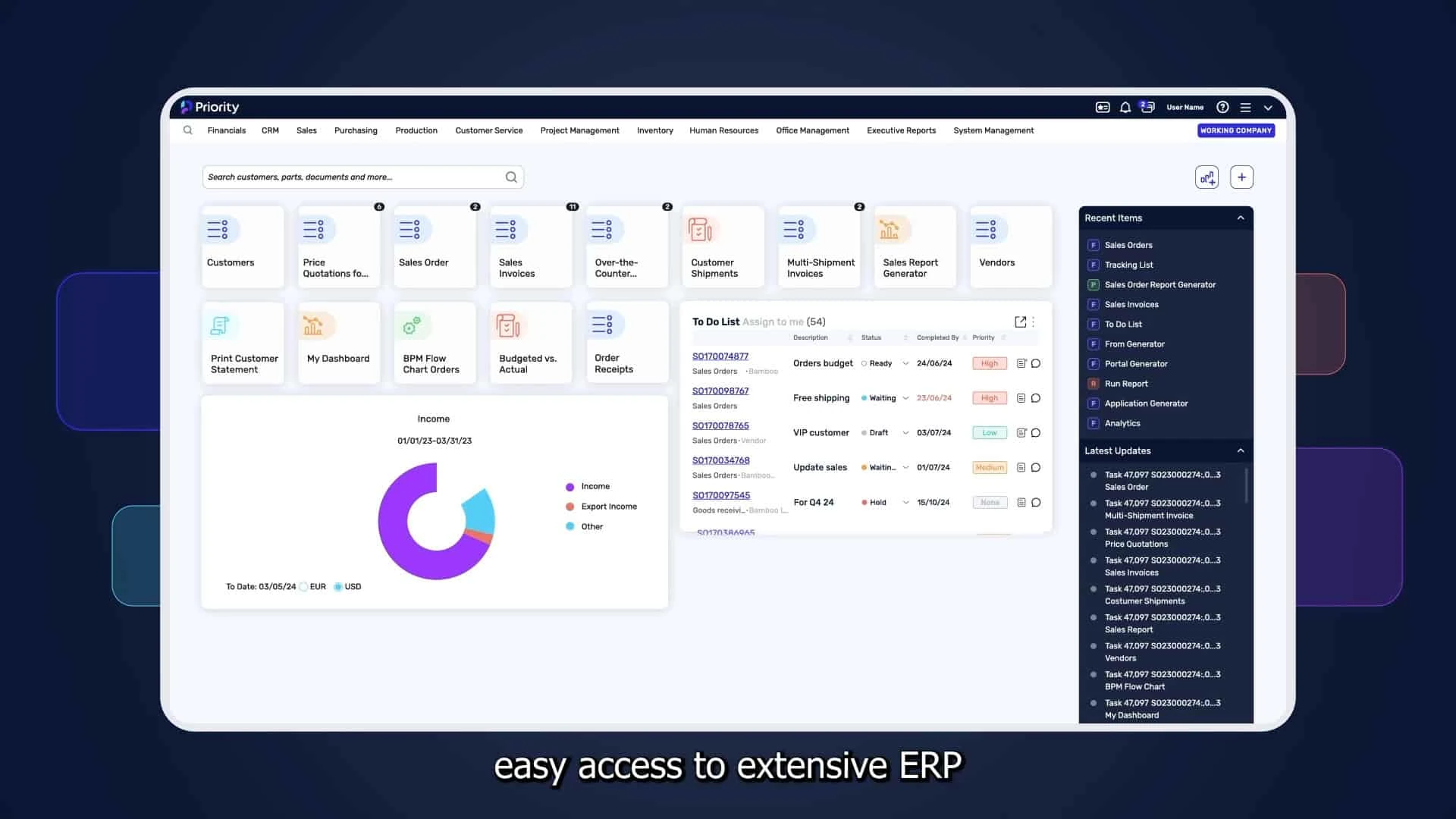
The Commercial configuration includes capabilities such as:
- General ledger and financials
- CRM
- Sales
- Purchasing
- Inventory control
- Office management
- Executive reporting and analytics
- Business process management
- Mobile functionality
- System administration
The Manufacturing configuration adds capabilities including:
- Manufacturing
- Production planning
- Engineering/change control
- Fixed assets
- Purchase planning
Who should consider Priority ERP?
Priority can be particularly relevant to organisations that need more than basic accounting and want an integrated platform covering operational and financial processes.
It is worth evaluating for businesses involved in:
- Manufacturing
- Distribution
- Wholesale
- Retail
- Professional services
- Construction
- Healthcare
- Pharmaceuticals
- Multi-entity operations
Priority also maintains industry-specific solutions across areas such as manufacturing, retail, construction, healthcare, pharmaceuticals and professional services.
How much does Priority ERP cost in Kenya?
Priority does not publish a standard Kenya retail price on its public pricing page.
Instead, prospective customers are directed to sales experts for pricing based on requirements.
That is important.
It would be inaccurate to publish a made-up figure such as “Priority ERP costs KSh X per user” without a formal quotation.
The final cost can depend on factors such as:
- Number of users
- Modules
- Deployment
- Manufacturing requirements
- Integrations
- Customisation
- Implementation
- Training
- Support
For a Kenyan business, the correct way to establish the cost is through a requirements assessment and formal proposal.
Priority ERP and GTL
Genome Technologies Ltd(GTL) is a Priority ERP partner and positions Priority ERP as a core enterprise resource-planning solution for Kenyan and African organisations.
This is particularly relevant if your business wants a local implementation partner rather than purchasing software without implementation assistance.
Best fit: Growing and mid-sized organisations requiring broad operational and financial functionality.
2. Odoo
What is Odoo?
Odoo is a modular business-management platform with applications covering areas including:
- Accounting
- Sales
- CRM
- Inventory
- Manufacturing
- Purchasing
- HR
- Project management
- POS
- eCommerce
- Website management
Odoo’s current pricing page lists all-app plans rather than requiring customers to purchase each business application separately.
Odoo pricing
Odoo currently publishes the following global list prices:
Standard
US$31.10 per user per month at the published list price.
Odoo currently displays a promotional price of US$24.90 per user per month for the initial period under its annual billing arrangement.
Custom
US$61 per user per month at the published list price, with a promotional price of US$49 per user per month shown on Odoo’s current pricing page.
The Custom plan adds capabilities including:
- Odoo Studio
- Multi-company
- External API
- Odoo Online
- Odoo.sh
- On-premise deployment options
Odoo notes that Odoo.sh hosting is not included in the listed Custom licence price.
Approximate Kenyan shilling equivalent
Using the CBK published monthly average USD/KES rate of KSh129.49 per US$1 on 20 August 2026, the published list prices work out approximately as follows:
- US$31.10 ≈ KSh4,026 per user/month
- US$61 ≈ KSh7,899 per user/month
- US$24.90 ≈ KSh3,224 per user/month
- US$49 ≈ KSh6,345 per user/month
These are currency conversions, not Kenyan Odoo quotations. Actual billing can differ because of exchange rates, taxes, billing arrangements and implementation costs. CBK states that its published exchange rate is a weighted-average market rate and that individual banks and forex providers may apply their own rates.
For example, at the published Standard list price, 10 users would represent approximately:
KSh40,260 per month before applicable taxes and implementation costs.
That is approximately KSh483,100 per year at that exchange rate.
Who should consider Odoo?
Odoo can be attractive to businesses wanting a broad suite of applications with a per-user subscription model.
It is particularly worth evaluating when a business needs combinations of:
- Accounting
- CRM
- Inventory
- Sales
- Purchasing
- Manufacturing
- HR
- Project management
- POS
- eCommerce
However, the licence price should not be mistaken for the total implementation cost.
Customisation, integrations, data migration and implementation services can add substantially to the project cost.
Best fit: SMEs and growing organisations wanting a modular, broad business platform.
3. SAP Business One
What is SAP Business One?
SAP Business One is SAP’s ERP platform aimed at small and midsize companies.
SAP describes Business One as covering:
- Accounting and financials
- Purchasing
- Inventory
- Sales
- Customer relationship management
- Reporting
- Analytics
It is therefore considerably broader than a basic accounting application.
How much does SAP Business One cost?
SAP does not publish a universal Kenya retail price for Business One on its public product page.
Instead, SAP directs prospective customers to request a quote based on their requirements.
That means any Kenyan website claiming that SAP Business One universally costs a particular amount should be treated cautiously unless it clearly identifies the specific licence, implementation scope, number of users and date of the quotation.
Who should consider SAP Business One?
SAP Business One can be appropriate for organisations looking for an established ERP platform with capabilities across:
- Finance
- Purchasing
- Inventory
- Sales
- CRM
- Reporting
It may be particularly relevant to established SMEs and midsize companies that require a structured ERP environment.
Best fit: Established small and midsize companies needing a broad ERP platform.
4. Microsoft Dynamics 365 Business Central
What is Business Central?
Microsoft Dynamics 365 Business Central is Microsoft’s business-management ERP product.
Microsoft describes Business Central as covering finance, sales, service and operations.
Its capabilities include:
- Finance management
- Sales
- Purchasing
- Inventory
- Supply-chain planning
- Warehouse management
- Project management
- Manufacturing in the Premium edition
Business Central pricing
Microsoft currently publishes:
Essentials
US$80 per user/month, paid yearly.
Premium
US$110 per user/month, paid yearly.
Team Members
US$8 per user/month, paid yearly.
Microsoft states that Premium includes the Essentials functionality plus enhanced service-management and manufacturing capabilities.
Using the CBK 20 August 2026 monthly average of KSh129.49 per US$1, those prices are approximately:
| Plan | USD/user/month | Approx. KES/user/month |
| Team Members | $8 | KSh1,036 |
| Essentials | $80 | KSh10,359 |
| Premium | $110 | KSh14,244 |
Again, these are currency conversions of Microsoft’s published US pricing, not a claim that these are the final Kenya purchase prices.
Microsoft also states that customers should contact a partner for purchase, assessment, consulting and additional pricing.
Who should consider Business Central?
Business Central can be particularly attractive to organisations already operating within the Microsoft ecosystem.
The platform can be worth considering where integration with Microsoft’s wider technology environment is important.
Best fit: Growing and established businesses seeking an ERP platform closely integrated with Microsoft technologies.
5. TallyPrime
What is TallyPrime?
TallyPrime is business-management software covering areas such as:
- Accounting
- Invoicing
- Inventory
- Banking and cash flow
- Business operations
Tally has a dedicated Kenya offering and specifically lists Kenya eTIMS among its product capabilities.
This makes TallyPrime particularly relevant to Kenyan businesses that want an established accounting and business-management application with local pricing.
TallyPrime Kenya pricing
Tally’s Kenya pricing page currently lists:
TallyPrime Silver
KSh57,600 + 16% VAT
The page identifies Silver as suitable for a business requiring TallyPrime on a single PC.
TallyPrime Gold
KSh172,800 + 16% VAT
Gold is intended for businesses requiring multi-user access across multiple PCs.
The listed VAT amounts are:
- Silver VAT: KSh9,216
- Gold VAT: KSh27,648
Therefore, the listed totals including the stated VAT are approximately:
- Silver: KSh66,816
- Gold: KSh200,448
Tally states that the licence includes one year of Tally Software Services, after which TSS renewal is required for its value-added services.
Who should consider TallyPrime?
TallyPrime may be a strong option for organisations whose main requirements centre on:
- Accounting
- Invoicing
- Inventory
- Banking
- Cash flow
- Business reporting
It is not necessarily the right choice for every organisation looking for a large-scale ERP transformation.
Best fit: Accounting- and inventory-focused SMEs and businesses looking for a locally priced established business-management system.
6. Sage 300cloud
What is Sage 300cloud?
Sage 300cloud is a business-management and ERP platform designed to support financial management and operational processes.
Sage’s Kenya site identifies capabilities including:
- Accounting and finance
- Sales and customer management
- Purchasing and supplier management
- Business intelligence and reporting
- Inventory and warehousing
- Customer service
How much does Sage 300cloud cost in Kenya?
Sage’s Kenyan product page does not present a universal public retail licence price for Sage 300cloud.
Therefore, a Kenyan business should request a quotation based on its:
- Users
- Modules
- Deployment
- Implementation
- Support requirements
- Integrations
Sage also offers separate products for different business requirements, including Sage Business Cloud Accounting and Sage 300 People.
It is therefore important not to treat the price of one Sage product as the price of the entire Sage ERP portfolio.
Best fit: Established organisations requiring financial management, distribution, purchasing and inventory capabilities.
7. Oracle NetSuite
What is NetSuite?
Oracle NetSuite is a cloud business-management platform that includes ERP, accounting, CRM and eCommerce capabilities.
Its broader ERP functionality covers areas such as:
- Financial management
- Inventory
- Order management
- Manufacturing
- Demand planning
- Supply planning
- Procurement
- Reporting
Oracle’s documentation covers these ERP capabilities in its NetSuite platform.
How much does NetSuite cost in Kenya?
Oracle does not publish a single universal Kenya price for a complete NetSuite implementation.
The appropriate cost depends on the selected modules, users, configuration and implementation requirements.
Therefore:
NetSuite: quote-based.
A prospective buyer should request a complete total-cost proposal rather than comparing only a software subscription with another ERP’s licence fee.
Best fit: Organisations seeking a broad cloud business-management platform and willing to undertake a structured ERP implementation.
ERP Software Prices in Kenya: What You Should Actually Compare
One of the biggest mistakes when comparing ERP software prices in Kenya is comparing only the licence.
A more useful calculation is:
Total ERP cost = software + implementation + migration + integration + training + support + infrastructure + customisation
For example, an ERP may have a relatively low subscription but require significant custom development.
Another system may have a higher licence price but require less customisation for a particular business process.
Therefore, the cheapest licence is not necessarily the cheapest ERP.
ERP Pricing Comparison
Based on publicly available pricing as checked in August 2026:
| ERP | Published price | Approx. Kenya equivalent | Implementation included? |
| Priority ERP | Quote | Quote | Depends on proposal |
| Odoo Standard | US$31.10/user/month list | ~KSh4,026/user/month | No; implementation options separate |
| Odoo Custom | US$61/user/month list | ~KSh7,899/user/month | No; implementation options separate |
| SAP Business One | Quote | Quote | Depends on partner/project |
| Dynamics 365 Business Central Essentials | US$80/user/month | ~KSh10,359/user/month | No |
| Dynamics 365 Business Central Premium | US$110/user/month | ~KSh14,244/user/month | No |
| TallyPrime Silver Kenya | KSh57,600 + VAT | KSh66,816 incl. stated VAT | Setup separate |
| TallyPrime Gold Kenya | KSh172,800 + VAT | KSh200,448 incl. stated VAT | Setup separate |
| Sage 300cloud | Quote | Quote | Depends on partner/project |
| NetSuite | Quote | Quote | Depends on implementation |
Important: The Odoo and Microsoft KES figures are currency conversions, not vendor-issued Kenya quotations. The conversion uses the CBK monthly average USD/KES rate published on 20 August 2026.
Tally’s figures are directly published in Kenyan shillings by Tally’s Kenya offering.
Priority, SAP Business One, Sage 300cloud and NetSuite should be treated as quote-based systems rather than assigning them unsupported Kenyan prices.
Why ERP Implementation Cost Matters
The software licence is only one part of an ERP project.
An implementation may involve:
1. Requirements analysis
The implementation team first needs to understand how the organisation currently works.
2. Configuration
The ERP is configured around the organisation’s approved processes.
3. Data migration
Existing customers, suppliers, products, opening balances and other records may need to be transferred.
4. Integration
The ERP may need to communicate with:
- Payment systems
- eCommerce platforms
- CRM systems
- Payroll
- Banking systems
- Tax systems
- Warehouse systems
- Other business applications
5. Customisation
Some organisations need functionality that is not available through standard configuration.
6. Testing
Workflows should be tested before production deployment.
7. Training
Employees need to understand the processes they are responsible for.
8. Go-live
The organisation moves from the previous systems into the ERP environment.
9. Post-implementation support
The first few weeks and months often reveal additional configuration, training and process requirements.
For a deeper discussion of ERP pricing, see GTL’s existing guide:
ERP Software Cost in Kenya: A Complete 2026 Pricing and ROI Guide.
Cloud ERP vs On-Premise ERP in Kenya
Another major decision is deployment.
Cloud ERP
A cloud ERP is hosted in a provider’s infrastructure and accessed over a network.
Potential advantages include:
- Reduced need for local server infrastructure
- Remote accessibility
- Easier centralised administration
- Scalable infrastructure
- Provider-managed infrastructure
However, businesses should investigate:
- Internet reliability
- Data location
- Backup policies
- Security controls
- Service availability
- Vendor exit procedures
- Integration requirements
On-premise ERP
With on-premise deployment, the organisation operates the software within infrastructure it controls or manages through a hosting arrangement.
Potential advantages can include greater infrastructure control and support for organisations with specific deployment requirements.
However, the organisation may have greater responsibility for:
- Servers
- Backups
- Security
- Infrastructure maintenance
- Updates
- Disaster recovery
There is no universal answer to whether cloud or on-premise ERP is better.
The right decision depends on the organisation’s technical requirements, risk profile, infrastructure, budget and operational model.
What ERP Modules Does Your Business Need?
You do not necessarily need every ERP module.
Financial management
Important for:
- General ledger
- Accounts payable
- Accounts receivable
- Financial reporting
- Budgeting
- Cash management
Inventory
Important if your organisation holds physical stock.
Look for:
- Stock control
- Multiple warehouses
- Stock transfers
- Reorder levels
- Batch/serial tracking where required
- Inventory valuation
Procurement
Useful where the business manages substantial supplier activity.
Look for:
- Purchase requisitions
- Purchase orders
- Supplier records
- Approval workflows
- Receiving
- Supplier performance
Manufacturing
Manufacturers should investigate:
- Bills of materials
- Production planning
- Work orders
- Material requirements planning
- Production costing
- Quality processes
- Work-in-progress
CRM and sales
Useful for businesses managing:
- Leads
- Opportunities
- Customers
- Quotations
- Sales orders
- Customer service
Human resources
Depending on the ERP, HR functionality can include:
- Employee records
- Leave
- Payroll
- Recruitment
- Performance
- Workforce management
Best ERP Software for Small Businesses in Kenya
A small business should not automatically buy the most sophisticated ERP available.
Instead, assess:
- Number of users
- Number of branches
- Accounting requirements
- Inventory requirements
- Sales volume
- Manufacturing requirements
- Reporting needs
- Integration requirements
- Growth plans
For some small businesses, accounting software may be sufficient.
For others, a modular platform such as Odoo or a business-management platform such as TallyPrime may be more appropriate.
A growing company with complex operations may need a more comprehensive ERP from the beginning.
The key is to choose based on business complexity, not simply employee count.
Best ERP Software for Manufacturing in Kenya
Manufacturing businesses have more complex ERP requirements than businesses that only sell finished products.
A manufacturing ERP should be evaluated for:
- Bills of materials
- Production planning
- Material requirements
- Purchasing
- Inventory
- Work orders
- Production costing
- Quality control
- Warehouse management
- Sales
- Financial management
- Reporting
Priority’s current Manufacturing configuration, for example, includes manufacturing, production planning, engineering/change control and fixed-asset capabilities in addition to its commercial functionality.
Microsoft Business Central Premium also includes manufacturing functionality beyond the Essentials edition.
The important point is to compare actual manufacturing capabilities, rather than assuming that every product marketed as an ERP has equivalent manufacturing depth.
Best ERP Software for Retail Businesses in Kenya
Retailers should pay particular attention to:
- Point of sale
- Inventory
- Purchasing
- Supplier management
- Multi-branch operations
- Stock transfers
- Customer management
- Financial reporting
- eCommerce integration
An ERP for a single shop has very different requirements from an ERP supporting dozens of branches.
For multi-location retail, investigate whether the system supports centralised stock visibility, branch reporting, user permissions and consolidated financial reporting.
Best ERP for Wholesale and Distribution
Distributors often need strong inventory and procurement functionality.
Important capabilities include:
- Multiple warehouses
- Purchase orders
- Supplier management
- Sales orders
- Customer credit
- Stock transfers
- Delivery management
- Inventory valuation
- Reordering
- Financial integration
- Management reporting
For a distributor, inventory accuracy can be more important than having a long list of optional ERP modules.
ERP for Multi-Branch Businesses
If your business operates multiple branches, ask whether the ERP can provide:
- Centralised financial reporting
- Branch-level reporting
- Inter-branch stock transfers
- Central procurement
- User permissions
- Consolidated accounts
- Branch performance reporting
- Central customer and supplier records
Do not assume that “multi-company” and “multi-branch” mean exactly the same thing.
Ask the ERP vendor to demonstrate the specific workflow your organisation needs.
eTIMS and ERP Software in Kenya
eTIMS should be part of the ERP evaluation process for Kenyan businesses.
KRA states that all persons carrying on business, including persons who are not VAT registered, are required to electronically generate and transmit invoices through eTIMS.
KRA also provides different eTIMS solutions and an API sandbox environment for integration-related development.
Therefore, when an ERP vendor says:
“Our ERP is eTIMS compliant”
do not stop there.
Ask:
- Is the integration direct?
- Is it through a third-party connector?
- Which eTIMS functionality is supported?
- Does the integration cover the invoices your business issues?
- How are errors handled?
- How are credit notes handled?
- How are system failures handled?
- Who maintains the integration when KRA changes requirements?
For example, Tally’s Kenya product documentation specifically lists Kenya eTIMS among its capabilities.
But compliance should always be verified against the current KRA requirements before implementation.
How to Choose the Right ERP Software in Kenya
Use this ten-point framework.
1. Define your business processes
Document what actually happens from:
Purchase → receive → store → sell → invoice → collect → report
For manufacturers, include:
Plan → procure → produce → inspect → store → sell → invoice
2. Identify your mandatory modules
Separate:
Must have
from:
Nice to have
3. Determine your user requirements
How many people need full access?
How many need limited access?
4. Consider branches and entities
Do you operate:
- One location?
- Multiple branches?
- Multiple companies?
- Multiple countries?
5. Evaluate integrations
Identify every system that needs to communicate with the ERP.
6. Evaluate deployment
Compare cloud, on-premise and hybrid requirements.
7. Evaluate implementation
Ask:
Who will actually implement this system?
The quality of implementation can matter as much as the software itself.
8. Calculate total cost of ownership
Don’t compare only subscription prices.
Calculate:
Licence + implementation + customisation + migration + integration + training + support + infrastructure
9. Test the system
Do not buy an ERP based solely on a presentation.
Ask the vendor to demonstrate your actual workflows.
10. Evaluate scalability
Ask:
Will this system still work if our transaction volume, users, branches and product catalogue double?
Questions to Ask an ERP Vendor Before Buying
Before signing an ERP contract, ask:
- What exactly is included in the licence?
- What is excluded?
- How much does implementation cost?
- How long is implementation expected to take?
- Who will implement the system?
- What data migration is included?
- What integrations are included?
- What customisation is included?
- How much do additional users cost?
- How are upgrades handled?
- What support is included?
- Where is the data hosted?
- How frequently is data backed up?
- How is disaster recovery handled?
- What happens if we leave the platform?
- Are there additional API charges?
- What eTIMS integration is available?
- Can the system handle multiple branches?
- Can it handle multiple companies?
- Can we speak to an existing customer with a similar business model?
The last question is particularly useful.
A software demonstration tells you what the system can do.
A customer reference can tell you what it is like to live with the system.
Common ERP Implementation Mistakes
Choosing based only on price
The cheapest licence may not produce the lowest total cost.
Buying too many modules
Don’t pay for functionality your organisation will never use.
Underestimating data migration
Poor-quality historical data can create major problems during implementation.
Ignoring staff training
Employees need to understand not just which buttons to press, but why the new workflow exists.
Excessive customisation
Customisation can increase implementation cost and make future upgrades more complicated.
Failing to define responsibilities
The customer and implementation partner should agree who is responsible for:
- Data preparation
- Testing
- Training
- Integrations
- Configuration
- Approvals
- Go-live
Treating ERP as an IT project only
ERP changes how departments work.
Finance, procurement, sales, warehouse, operations and management should all be involved.
How Long Does ERP Implementation Take?
There is no universally accurate ERP implementation timeline.
A simple implementation with limited users and standard processes can be significantly quicker than a multi-branch manufacturing implementation requiring extensive data migration and integrations.
The timeline can be affected by:
- Number of users
- Number of branches
- Number of modules
- Data quality
- Integrations
- Customisation
- User availability
- Decision-making speed
- Testing
- Training
Therefore, be cautious of an ERP provider promising that every implementation can be completed in a fixed number of days without first understanding the project scope.
Is ERP Software Worth the Investment?
ERP software can provide substantial value when it solves real operational problems.
Potential benefits include:
Better visibility
Management can access information from connected business processes.
Less duplicate data entry
Integrated workflows can reduce the need to enter the same information into multiple systems.
Better inventory control
Businesses can obtain more consistent information about stock movements and balances.
Faster reporting
Financial and operational data can be brought together for reporting.
Improved process control
Approval workflows can help standardise business processes.
Better scalability
A properly selected ERP can provide a foundation for additional users, branches and processes.
But ERP is not automatically beneficial simply because it is an ERP.
If the system is poorly selected, poorly configured or poorly adopted, the organisation may spend money without achieving the expected operational improvement.
The investment should therefore be evaluated against measurable business objectives.
What Should an ERP ROI Calculation Include?
Before purchasing an ERP, calculate:
Current costs
- Manual administration
- Duplicate data entry
- Spreadsheet maintenance
- Reporting time
- Inventory errors
- Stock losses
- Procurement inefficiencies
- Reconciliation work
- Existing software licences
Expected improvements
- Reduced processing time
- Improved stock accuracy
- Faster reporting
- Reduced manual work
- Better purchasing control
- Better sales visibility
- Improved management information
Then compare those expected benefits against the total cost of ownership.
Do not claim that an ERP will save a particular percentage unless the figure is supported by a documented study or actual customer data.
Which ERP Is Best for Your Business?
There is no single winner for every organisation.
Instead, consider the following:
| If your priority is… | Systems worth evaluating |
| Accounting and inventory | TallyPrime, Odoo, Sage |
| Broad modular business management | Odoo |
| Manufacturing and broader operations | Priority ERP, Business Central, SAP Business One |
| Microsoft ecosystem | Dynamics 365 Business Central |
| Established enterprise ERP environment | SAP Business One, Priority ERP, NetSuite |
| Multi-functional growing business | Priority ERP, Odoo, Business Central |
| Local Kenya-listed Tally pricing | TallyPrime |
| Custom enterprise requirements | Priority ERP, SAP Business One, Business Central, NetSuite |
This table is a starting point, not a product ranking.
The correct system depends on the organisation’s actual requirements.
So, What Is the Best ERP Software in Kenya?
If you are asking for the best ERP software in Kenya in absolute terms, the honest answer is:
There isn’t one.
The best ERP is the one that fits your:
- Business model
- Industry
- Processes
- Budget
- Number of users
- Branch structure
- Reporting requirements
- Integration requirements
- Compliance requirements
- Growth plans
For example, a company looking primarily for accounting and inventory management may find TallyPrime appropriate.
A company wanting a modular suite across accounting, CRM, inventory, sales and manufacturing may evaluate Odoo.
A business requiring an ERP within a Microsoft technology environment may consider Business Central.
A growing organisation seeking broader operational, manufacturing and financial functionality may evaluate Priority ERP.
An established organisation may consider SAP Business One or NetSuite depending on its requirements.
The important thing is not to ask:
“Which ERP is cheapest?”
Instead ask:
“Which ERP gives our organisation the functionality, control, scalability and total cost of ownership we need?”
Why GTL Recommends a Needs-Based ERP Approach
At GTL, we believe ERP selection should begin with the business rather than the software.
The process should start with understanding:
- What the organisation currently does
- Where bottlenecks occur
- Which processes are manual
- Where data is duplicated
- Which reports management needs
- Which departments need integration
- Which statutory requirements apply
- What the organisation expects to achieve from the ERP
GTL provides ERP solutions based around Priority ERP and Cloud ERP, with solutions covering finance, HR, supply chain, retail, hospitality and manufacturing.
Priority’s own platform provides functionality across financials, CRM, sales, purchasing, inventory, manufacturing, analytics and other business processes.
That makes a requirements-led assessment more useful than simply comparing licence prices.
Get an ERP Assessment for Your Business
If you are considering ERP software in Kenya, GTL can help you evaluate your requirements before you commit to a system.
Instead of starting with:
“How much does ERP cost?”
start with:
“What should our ERP actually do?”
A proper assessment can help identify:
- Required modules
- Number of users
- Business processes
- Integration requirements
- Reporting requirements
- Deployment requirements
- Implementation considerations
- Expected investment
Ready to evaluate your ERP requirements?
Talk to GTL about your business requirements and request an ERP consultation.
The objective is not simply to sell you software.
It is to determine whether an ERP solution is appropriate for your organisation, what functionality you need and how the implementation should be approached.
Frequently Asked Questions About ERP Software in Kenya
What is the best ERP software in Kenya?
There is no single ERP that is best for every Kenyan business. The appropriate system depends on the organisation’s size, industry, users, processes, required modules, integrations, budget and growth plans.
How much does ERP software cost in Kenya?
ERP software prices in Kenya vary considerably. Some products publish subscription or licence prices, while enterprise ERP platforms often use quote-based pricing. For example, TallyPrime currently publishes Kenya prices from KSh57,600 before the stated VAT for its Silver licence, while Odoo and Microsoft publish international per-user pricing. Priority ERP, SAP Business One, Sage 300cloud and NetSuite use quote-based pricing for the products considered in this guide.
What is the cheapest ERP system in Kenya?
There is no single objectively cheapest ERP because licence price is only one part of total cost. A system with a low subscription may require additional implementation, integration or customisation costs. Businesses should compare total cost of ownership rather than licence price alone.
Is Odoo available in Kenya?
Yes. Odoo is a globally available business-management platform, and Kenyan businesses can purchase Odoo subscriptions and work with implementation partners. Odoo’s current pricing includes Standard and Custom plans.
How much does Odoo cost in Kenya?
Odoo’s current published list price is US$31.10 per user per month for Standard and US$61 per user per month for Custom, before applicable taxes. Using the CBK monthly average USD/KES rate published on 20 August 2026, these are approximately KSh4,026 and KSh7,899 respectively. These are currency conversions rather than Kenya-specific quotations.
How much does TallyPrime cost in Kenya?
Tally’s Kenya pricing currently lists TallyPrime Silver at KSh57,600 plus 16% VAT and TallyPrime Gold at KSh172,800 plus 16% VAT. Tally describes Silver as a single-PC licence and Gold as a multi-user option for multiple PCs.
How much does Microsoft Dynamics 365 Business Central cost?
Microsoft currently lists Business Central Essentials at US$80 per user per month and Premium at US$110 per user per month when paid yearly. These are Microsoft’s published prices and should not be interpreted as a final Kenya implementation quotation.
How much does SAP Business One cost in Kenya?
SAP does not publish one universal Kenya price for Business One on its public product page. SAP directs prospective customers to request a quote based on their requirements.
Does ERP software need to support eTIMS?
Businesses should evaluate eTIMS requirements as part of their ERP selection process. KRA requires persons carrying on business to electronically generate and transmit invoices through eTIMS, subject to the applicable rules and exceptions.
Is cloud ERP better than on-premise ERP?
Neither deployment model is universally better. Cloud ERP can reduce the need for locally managed infrastructure, while on-premise deployment can provide organisations with greater control over their infrastructure. The appropriate choice depends on business, technical, security and operational requirements.
Which ERP is best for manufacturing in Kenya?
Manufacturers should compare ERP systems based on production planning, bills of materials, inventory, procurement, production control, costing, quality processes and reporting. Priority ERP and Microsoft Dynamics 365 Business Central, for example, publish manufacturing capabilities within their respective product configurations.
Which ERP is best for a small business in Kenya?
There is no universal answer. Small businesses should first establish whether they need a full ERP or whether accounting and selected business applications are sufficient. TallyPrime, Odoo and other systems may be worth evaluating depending on the business processes involved.
How long does ERP implementation take?
There is no fixed implementation period that applies to every business. The timeline depends on users, modules, branches, data migration, integrations, customisation, testing and organisational readiness.
Is ERP software worth the investment?
ERP can be worthwhile when it solves measurable business problems such as fragmented data, inefficient processes, weak inventory control or slow reporting. The investment should be evaluated using total cost of ownership and measurable expected business outcomes.
Final Takeaway
The best ERP software in Kenya is not necessarily the cheapest system, the system with the most features or the system with the biggest global name.
It is the system that fits your organisation.
Before choosing an ERP, compare:
Functionality + implementation + integration + support + scalability + compliance + total cost of ownership.
And most importantly, make the decision based on your actual business processes.
If you are evaluating ERP for a growing Kenyan business, GTL can help you assess those requirements and determine whether Priority ERP is an appropriate fit for your organisation.
Request an ERP consultation from GTL and start with your business requirements—not a software price tag.
Sources and factual basis
This guide was researched using current vendor documentation and authoritative Kenyan sources, including:
- Kenya Revenue Authority — eTIMS requirements and electronic tax invoicing.
- Central Bank of Kenya — published exchange-rate information.
- Kenya National Bureau of Statistics — Economic Survey and official statistics.
- Communications Authority of Kenya — ICT and connectivity statistics.
- State Department for MSME Development — Kenyan MSME information.
- Priority Software — current product capabilities and pricing structure.
- Odoo — current published pricing and plans.
- Microsoft — current Dynamics 365 Business Central pricing and capabilities.
- SAP — Business One product information and quotation model.
- Tally Solutions — current Kenya TallyPrime pricing and features.
- Sage Kenya — Sage 300cloud capabilities.
- Oracle — NetSuite product information.