Kenyan businesses are paying increasing attention to eTIMS stock management as the Kenya Revenue Authority (KRA) continues to develop electronic invoicing and stock-management functionality.
On 7 September 2026, KRA issued a public notice informing taxpayers engaged in business that they are required to maintain accurate and up-to-date stock records while using TIMS/eTIMS in accordance with the law.
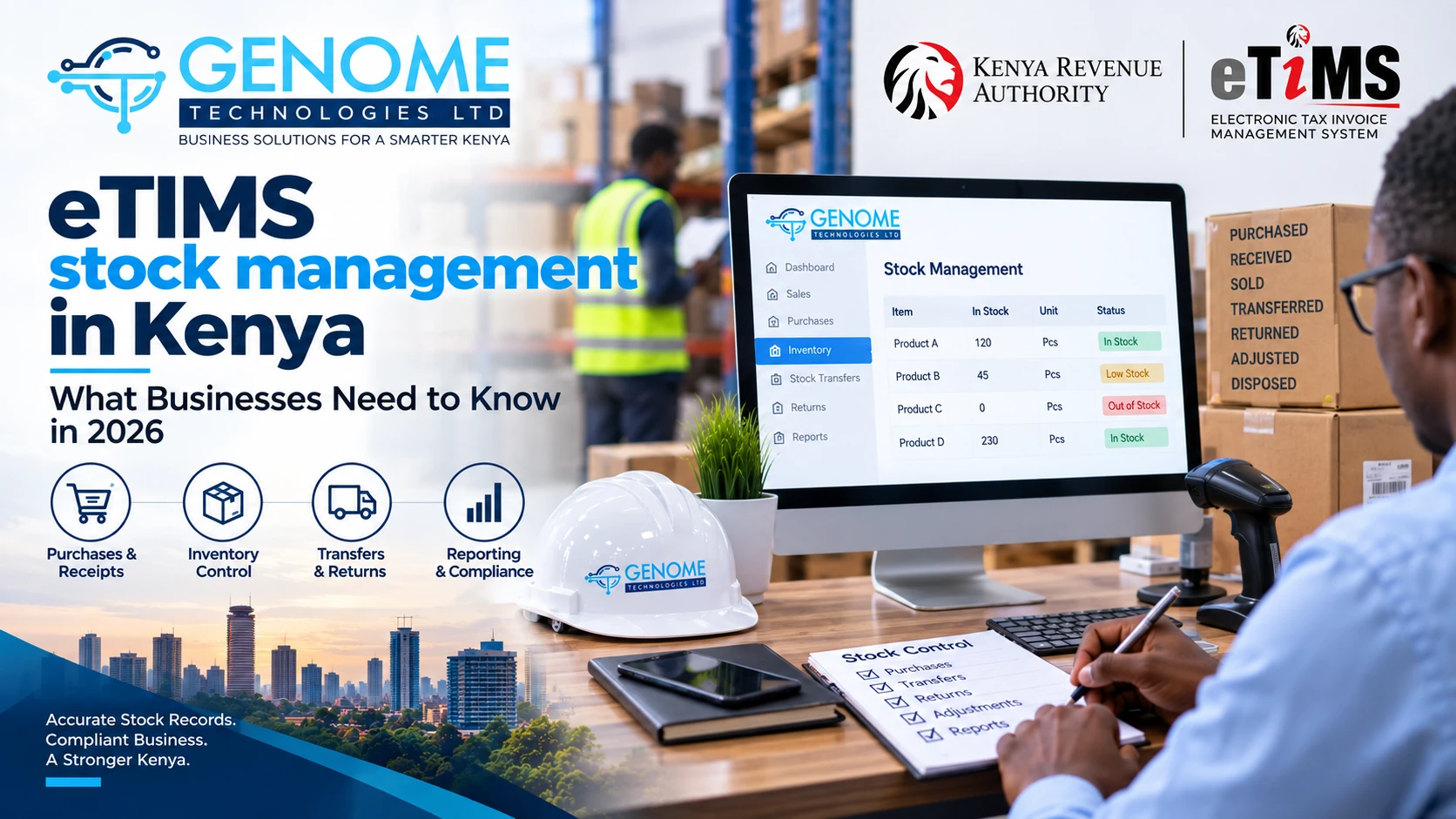
KRA says these records should account for goods as they move through a business, including stock purchased or received, sold, transferred, returned, adjusted or otherwise disposed of.
KRA also stated that consultative engagement forums with the business community and other stakeholders are expected to commence in September 2026. The purpose is to help stakeholders understand how the stock-management functionality works, raise questions, discuss implementation challenges and provide recommendations.
This makes eTIMS stock management an important issue for Kenyan businesses that handle physical goods.
But what exactly does it mean for your business?
What Is eTIMS Stock Management?
eTIMS is the Kenya Revenue Authority’s electronic Tax Invoice Management System.
According to KRA, eTIMS is a software solution that gives taxpayers options for electronic invoicing. KRA states that all persons engaged in business are required to onboard onto eTIMS and issue electronic tax invoices.
KRA also explains that the eTIMS stock management module assists taxpayers in maintaining their own inventory.
The current discussion around eTIMS stock management therefore goes beyond simply issuing electronic invoices.
Businesses that hold and move stock need reliable records showing how goods enter, move through and leave the business.
According to KRA’s September 2026 public notice, stock records should account for goods that are:
- Purchased or received
- Sold
- Transferred
- Returned
- Adjusted
- Otherwise disposed of in the course of business
The objective is accurate stock management that supports compliance with tax obligations and improves the accuracy of tax returns and reporting.
What Has KRA Said About eTIMS Stock Management?
KRA’s 7 September 2026 public notice is the most important primary source for businesses trying to understand the current position.
KRA states:
“The stock records should accurately account for goods as they move through the business.”
KRA further states that accurate stock management will support compliance with tax obligations and improve the accuracy of tax returns and reporting.
Importantly, KRA has also announced stakeholder consultations.
The Authority says these consultations will provide an opportunity for businesses and other stakeholders to:
- Understand how the stock-management functionality works
- Seek clarification
- Share implementation challenges
- Provide recommendations
- Help inform appropriate enhancements
This means businesses should pay attention to official KRA communication as implementation develops rather than relying on assumptions or social-media interpretations.
Why Does eTIMS Stock Management Matter to Businesses?
For a business that buys, stores and sells physical products, stock records are already an important part of daily operations.
A business needs to know what it purchased, what it received, what it sold and what remains available.
The current focus on eTIMS stock management makes accurate digital records even more important.
Consider a distributor with several warehouses.
Stock may move from a supplier into a central warehouse and then to different branches. Some goods may subsequently be sold, returned or adjusted.
Without reliable records, it becomes difficult to establish an accurate picture of stock movements.
The same applies to retailers, wholesalers, manufacturers, hospitality businesses and other organisations that handle inventory.
What Stock Movements Should Businesses Track?
KRA’s September 2026 notice specifically identifies several types of stock movement.
Stock Purchased or Received
Businesses should maintain records of goods entering the business through purchases or other receipts.
Stock Sold
Businesses need records of goods that leave the business through sales.
Stock Transferred
Where stock moves between locations or parts of a business, the movement should be reflected in the relevant stock records.
Stock Returned
Returned goods are also part of the stock-management picture.
Stock Adjusted
Businesses may make legitimate adjustments to stock records. Such movements need to be reflected accurately.
Stock Disposed Of
KRA’s notice also includes goods otherwise disposed of in the course of business.
These categories demonstrate why eTIMS stock management is not simply about recording sales invoices.
It requires businesses to maintain an accurate picture of how goods move through their operations.
Does eTIMS Replace Inventory Management?
Not necessarily.
KRA explains that the eTIMS stock management module assists taxpayers in maintaining their own inventory.
However, businesses with complex operations may also use dedicated inventory or ERP systems to manage their wider business processes.
KRA provides system-to-system integration for businesses that already have an invoicing system and want to integrate it with eTIMS.
According to KRA, this integration can connect a taxpayer’s invoicing or ERP system to eTIMS through an API.
KRA identifies two integration approaches:
- Virtual Sales Control Unit (VSCU)
- Online Sales Control Unit (OSCU)
KRA states that VSCU allows system-to-system integration between a taxpayer’s invoicing/ERP system and eTIMS and is suitable for taxpayers undertaking bulk invoicing.
OSCU also supports integration between an invoicing/ERP system and eTIMS and is suitable for taxpayers whose invoicing is always online.
This is particularly relevant when evaluating eTIMS stock management alongside existing business software.
eTIMS Stock Management and ERP Systems
An ERP system can bring different business functions together in one environment.
Depending on the system and configuration, these functions may include:
- Finance
- Purchasing
- Sales
- Inventory
- Warehousing
- Manufacturing
- Customer management
- Reporting
For a business with complex inventory operations, the value of an ERP is not simply having another invoicing screen.
The objective is to connect business processes and maintain consistent information across departments.
For example:
Purchasing → Receiving → Inventory → Sales → Invoicing → Finance → Reporting
The exact workflow depends on the organisation and the ERP configuration.
GTL provides Priority ERP solutions covering areas such as financials, supply chain, inventory, warehouse operations, manufacturing, retail, sales and reporting.
Businesses evaluating eTIMS stock management can therefore look at both sides of the requirement:
- What KRA requires for electronic invoicing and stock records.
- What the business needs to manage its operations effectively.
These are related, but they are not necessarily the same thing.
What Should Businesses Do About eTIMS Stock Management?
Businesses should start with their existing processes.
Before purchasing new software, document how stock currently moves through the organisation.
For example:
Supplier → Purchase → Receiving → Warehouse → Branch → Sale → Return or Adjustment
Then identify where records are currently maintained.
Are they stored in:
- Excel spreadsheets?
- Accounting software?
- A point-of-sale system?
- An inventory system?
- An ERP?
- Paper records?
- Several systems at the same time?
This exercise can reveal gaps before a business makes technology decisions.
Step 1: Review Your Current Stock Records
Start by determining whether your stock records are accurate and up to date.
Compare system records with actual stock where appropriate.
Look for unexplained differences and identify how adjustments are currently documented.
The aim should be to establish a reliable starting point.
Step 2: Map Your Stock Movements
Document how goods enter, move through and leave your business.
Include purchases, receipts, sales, transfers, returns, adjustments and disposal where applicable.
This gives management a clearer understanding of the processes that need to be supported.
Step 3: Review Your eTIMS Setup
KRA provides different eTIMS solutions depending on taxpayer requirements.
Businesses should review their current setup and consult KRA’s official guidance where they need clarification.
For businesses with existing invoicing or ERP systems, KRA also provides information about system-to-system integration.
Step 4: Identify Gaps
Ask practical questions.
Can your current system show:
- What stock was received?
- What was sold?
- What was transferred?
- What was returned?
- What was adjusted?
- What remains in stock?
- Which location currently holds the stock?
The answers can help determine whether existing systems are adequate.
Step 5: Evaluate Integration
If your business already operates an ERP, POS or invoicing system, determine how it can work with eTIMS.
KRA’s system-to-system integration guidance specifically addresses businesses with existing invoicing or ERP systems.
Do not assume that two systems automatically exchange the information you need.
Ask your software provider to explain the integration, supported processes and responsibilities for maintaining it.
Step 6: Follow KRA’s Official Updates
The current KRA notice says stakeholder consultations on the stock-management functionality are expected to commence in September 2026.
Businesses should therefore follow official KRA communication as the process develops.
Avoid treating social-media posts, informal explanations or third-party articles as substitutes for KRA’s official guidance.
What Should You Look for in an Inventory or ERP System?
If your business decides that its current systems are not sufficient, eTIMS stock management should be considered alongside broader operational requirements.
Look for a system that can support the actual processes of your business.
Important capabilities may include:
Inventory Management
The system should provide clear visibility of stock and stock movements.
Purchasing
Purchasing processes should connect appropriately with receiving and inventory records.
Sales
Sales transactions should be connected to the relevant inventory processes.
Warehouse Management
Businesses with multiple storage locations may require more advanced warehouse functionality.
Multi-Branch Operations
Businesses with several branches should consider how stock transfers and branch-level records are managed.
Reporting
Management should be able to obtain useful reports from reliable underlying data.
Financial Integration
Where appropriate, inventory transactions should connect with financial processes.
eTIMS Integration
If integration with eTIMS is required, ask exactly how the proposed system connects with KRA’s approved integration framework.
KRA’s official system-to-system guidance explains that taxpayers can integrate their invoicing or ERP systems with eTIMS through APIs using OSCU or VSCU.
eTIMS Stock Management for Retail Businesses
Retailers often deal with frequent stock movements.
A typical retailer may purchase products, receive them into a warehouse, transfer them to branches, sell them through POS systems and process returns.
For these businesses, accurate stock records can be particularly important.
GTL’s retail ERP solution, based on Priority ERP, includes inventory, supply-chain management, warehouse management, POS integration, purchasing and reporting capabilities.
Businesses evaluating eTIMS stock management can therefore consider whether their retail system provides the operational controls they need in addition to electronic invoicing.
eTIMS Stock Management for Wholesalers and Distributors
Wholesalers and distributors can have more complicated stock movements because products may pass through multiple warehouses, branches and customers.
A suitable system may need to support:
- Multiple warehouses
- Stock transfers
- Purchasing
- Sales
- Customer management
- Inventory visibility
- Reporting
- Financial integration
The important consideration is whether the system accurately represents the way the business actually operates.
eTIMS Stock Management for Manufacturers
Manufacturers have another layer of complexity.
Materials may be purchased, received, stored, issued for production and converted into finished products.
The business may then store and sell the finished goods.
An ERP can help connect these processes, but businesses should evaluate the actual functionality rather than assuming every ERP handles manufacturing in the same way.
eTIMS Stock Management for Agribusinesses
Agribusinesses can also have complex inventory and operational records.
Depending on the business, these may include agricultural inputs, livestock-related records, harvested products, supplies and sales.
GTL also provides farm-management software solutions for Kenyan agricultural businesses through Farmbrite.
The appropriate technology depends on whether the organisation needs farm-management functionality, broader ERP functionality or an integrated combination.
Common Mistakes Businesses Should Avoid
1. Waiting Until the Last Minute
Businesses should understand their current stock processes before implementation becomes urgent.
2. Assuming eTIMS Is Only About Invoices
KRA’s current stock-management notice specifically addresses stock records and movements.
3. Using Unreconciled Stock Data
Technology cannot compensate for inaccurate underlying records.
4. Buying Software Without Mapping Processes
Start with the business process.
Then choose technology that supports it.
5. Assuming Every ERP Has the Same eTIMS Capability
Ask the vendor to explain exactly how its system works with eTIMS.
6. Relying on Unofficial Information
For tax-compliance questions, use KRA’s official guidance as the primary reference.
Frequently Asked Questions About eTIMS Stock Management
What is eTIMS stock management in Kenya?
eTIMS stock management refers to the stock-management functionality associated with KRA’s electronic invoicing system. KRA states that taxpayers using TIMS/eTIMS are required to maintain accurate and up-to-date stock records in accordance with the law.
What stock movements does KRA mention?
KRA’s 7 September 2026 public notice identifies stock purchased or received, sold, transferred, returned, adjusted or otherwise disposed of in the course of business.
Has KRA announced a new deadline for eTIMS stock management?
KRA’s 7 September 2026 notice does not state a universal new deadline. It says consultative engagement forums are expected to commence in September 2026 to support implementation of the stock-management functionality.
Does eTIMS include stock management?
Yes. KRA’s eTIMS information states that the stock management module assists taxpayers in maintaining their own inventory.
Can an ERP system integrate with eTIMS?
Yes. KRA provides system-to-system integration for businesses with existing invoicing or ERP systems. KRA identifies OSCU and VSCU as integration options.
Does every business need a full ERP system?
Not necessarily.
Businesses have different levels of complexity. The appropriate system depends on factors such as the number of users, branches, inventory requirements, financial processes, manufacturing needs and integration requirements.
What should a business do now?
Review your stock records, map your stock movements, review your eTIMS setup, identify gaps and follow official KRA communication as implementation develops.
Final Takeaway
The current eTIMS stock management discussion is an important development for Kenyan businesses that handle physical goods.
KRA’s message is clear: businesses using TIMS/eTIMS are required to maintain accurate and up-to-date stock records, with those records accounting for relevant movements of goods through the business.
The practical response is not simply to purchase software.
Start by understanding your stock.
Know how goods enter the business.
Know how they move.
Know how they leave.
Then evaluate whether your current systems can maintain accurate records and support your wider business processes.
For organisations with more complex operations, an integrated ERP can provide a way to connect inventory, purchasing, sales, finance, warehousing and reporting while supporting the business’s electronic invoicing requirements.
GTL helps Kenyan businesses evaluate and implement business-management solutions based on their operational requirements.
If you are reviewing your inventory processes or preparing your business for the evolving eTIMS environment, talk to GTL about your requirements and explore an ERP solution designed around the way your business operates.
Official sources
This article is based primarily on information published by the Kenya Revenue Authority, particularly its September 2026 public notice on stock-management functionality and its official eTIMS guidance.
For compliance decisions, always refer to the latest information issued directly by KRA.